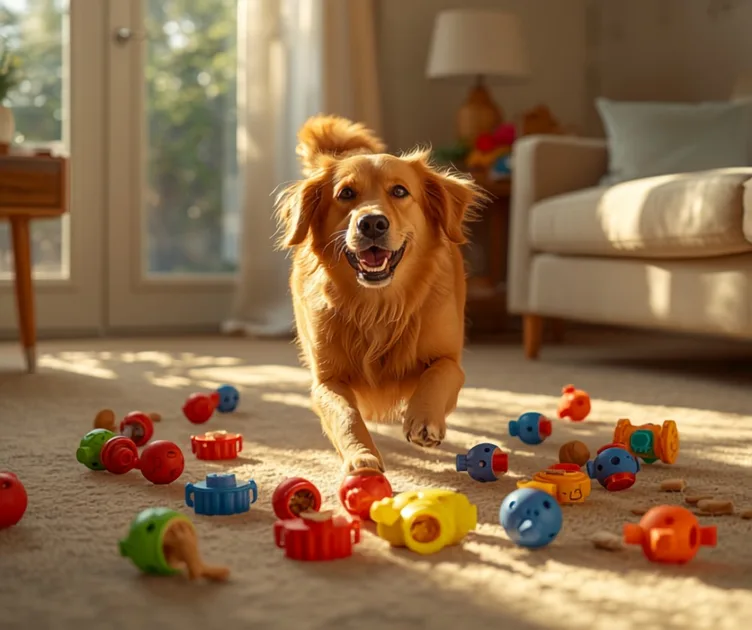
Best Interactive Dog Toys to Prevent Boredom in 2026 — Expert Picks for Every Breed
📅 June 27, 2026 · ⏱ 19 min read · By Arbsbuy Pet Experts
⚡ Quick Answer
The best interactive dog toys match your dog’s specific play drive: chewers need durable rubber toys (Kong Classic, West Paw Zogoflex); scent-driven dogs benefit most from snuffle mats and nose-work games; high-energy dogs need fetch toys and tug ropes; anxious dogs benefit most from food-dispensing toys that provide calm, repetitive engagement. The most evidence-supported form of dog enrichment is nose work — 15–20 minutes of scatter feeding or snuffle mat feeding provides greater mental fatigue than a 30-minute walk, measured by lower post-activity cortisol levels.
💡 Expert Tip
Fill a Kong with your dog’s regular kibble moistened with a small amount of low-sodium broth, pack it firmly, and freeze overnight. Use it as the morning meal. This converts a 5-minute eating event into 30–45 minutes of calm, focused enrichment — significantly reducing morning hyperactivity, and for dogs left home alone, it provides constructive occupation during the highest-anxiety period immediately after departure.
🧩
Written by the Arbsbuy Pet Care Team
Expert-reviewed | Published: June 15, 2026 | Arbsbuy LLC — U.S. Registered Pet Store
🕐 12 min read📝 3,200+ words🐶 Dog Enrichment✅ Expert reviewed
A bored dog is a destructive dog. Chewed furniture. Incessant barking. Dug-up garden beds. Scratched doors. If you are living with a dog that seems to constantly find trouble, the solution is almost certainly not more discipline — it is more mental stimulation. And the most effective, affordable, and enjoyable way to provide that stimulation is with the right interactive dog toys.
In 2026, the market for interactive dog toys has never been more advanced — or more confusing to navigate. Hundreds of options compete for your attention, from simple puzzle feeders to AI-powered toys that adapt to your dog’s behavior patterns. Knowing which interactive dog toys genuinely deliver results — and which are novelties that lose a dog’s interest within minutes — requires expert guidance.
In this complete guide, we cover why dogs need interactive toys, the warning signs of canine boredom, the different types of interactive toys available, and our expert picks for the best interactive dog toys of 2026 — organized by dog size, breed type, and difficulty level.
🐾 Quick Answer
The best interactive dog toys for 2026 are puzzle treat dispensers (best for mental stimulation), snuffle mats (best for natural foraging), and durable chew toys with treat-filling capability (best for solo engagement). Choose based on your dog’s size, intelligence level, and how much supervision you can provide. Rotate toys every 3–5 days to maintain engagement.
Why Dogs Desperately Need Mental Stimulation
Before choosing the best interactive dog toys for your dog, it is important to understand why mental stimulation is not optional for dogs — it is a genuine health need. Dogs are highly intelligent animals whose brains are designed to be actively engaged. In the wild, a dog would spend the majority of its day using its mind and senses — tracking scents, problem-solving to find food, navigating terrain, and communicating with its pack.
The average modern indoor dog sleeps 12–14 hours per day and spends the remaining waking hours in an environment that provides almost no cognitive challenge. This chronic under-stimulation is a leading cause of behavioral problems in pet dogs — and research increasingly confirms that mental exercise is as important as physical exercise for a dog’s overall health and happiness.
15Minutes of puzzle play can tire a dog as much as a 30-min walk
80%Of destructive behaviors linked to boredom and under-stimulation
68%Of dog owners report reduced anxiety with daily interactive play
30%Less barking reported in dogs with daily mental enrichment activities
🧠
Cognitive Development
Regular puzzle play builds problem-solving skills, improves memory, and keeps aging dogs mentally sharp — reducing cognitive decline risk.
😌
Anxiety Reduction
Mental focus on a toy or puzzle displaces anxious thinking. Interactive toys are particularly effective for separation anxiety when owners leave.
🏠
Prevents Destructive Behavior
A mentally engaged dog has no need to chew furniture, bark excessively, or dig. Interactive toys redirect energy into productive, rewarding activity.
❤️
Strengthens Bond
Playing interactive games with your dog — hiding treats, working through puzzles together — deepens the human-dog relationship significantly.
😴
Better Sleep
Dogs that receive adequate mental stimulation sleep more soundly and have more consistent, restful sleep patterns — less nighttime restlessness.
🐾
Physical Health
Many interactive toys also encourage movement — sniffing, pawing, running — providing a combined mental and physical workout in a single session.
“Mental stimulation is not a luxury for dogs — it is a biological necessity. A dog that is cognitively under-stimulated is like a person confined to a blank room with nothing to read, watch, or do. The behavioral consequences are inevitable.”
— Dr. Alexandra Horowitz, Author of Being a Dog and Director of the Dog Cognition Lab, Barnard College
8 Warning Signs Your Dog Is Bored and Needs Interactive Toys
How do you know if your dog needs more interactive mental stimulation? These eight behaviors are the most reliable warning signs that your dog’s cognitive needs are not being met:
🛋️Chewing furniture, shoes, or household items
🔊Excessive, repetitive barking — especially when alone
🌀Repetitive behaviors like tail chasing or pacing
🪴Digging in the garden or scratching at doors
😟Significant anxiety when you leave the house
😴Excessive sleeping and general listlessness during the day
😤Hyperactivity and inability to settle — bouncing off the walls
If your dog displays three or more of these behaviors regularly, increasing daily mental stimulation with interactive dog toys should be your first intervention — before considering training classes or behavioral consultations. In many cases, the behaviors resolve completely once the dog’s cognitive needs are consistently met.
Interactive toys engage your dog’s natural foraging instincts and provide essential mental stimulation.7 Types of Interactive Dog Toys Explained
Not all interactive dog toys are the same — and understanding the different types helps you choose the right one for your dog’s personality, breed, and intelligence level.
1. Puzzle Toys and Treat Dispensers
The most cognitively demanding category of interactive dog toys. Puzzle toys challenge dogs to slide, lift, rotate, or otherwise manipulate compartments to access hidden treats. They come in multiple difficulty levels — from beginner designs with simple flap covers, to advanced multi-step puzzles requiring dogs to complete a sequence of actions. Treat dispensers roll or spin unpredictably, releasing kibble as the dog interacts with them. Both types are excellent for feeding meals in a more engaging way, slowing fast eaters, and providing solo mental stimulation.
2. Snuffle Mats
Snuffle mats tap into a dog’s extraordinary sense of smell — which is estimated to be 10,000 to 100,000 times more sensitive than a human’s. Kibble or treats are hidden in the dense fabric strips of the mat, and the dog must use its nose to locate each piece. This form of scent work is deeply satisfying for dogs and surprisingly tiring — 15 minutes of snuffle mat activity can mentally exhaust a dog as effectively as a 30-minute walk. According to the AKC, nose work activities are particularly beneficial for anxious dogs as the focused sniffing releases calming neurotransmitters.
3. Durable Chew Toys with Treat Filling
Chew toys designed with hollow interiors — filled with peanut butter, kibble, or wet food — provide extended solo engagement. The dog must work continuously to extract the filling, keeping them occupied for 20–45 minutes depending on what is inside. Frozen versions (filling the toy and freezing overnight) last even longer and provide cooling relief in warm weather. These are ideal for dogs left alone and dogs working through separation anxiety.
4. Tug and Interactive Fetch Toys
Tug toys require human participation — making them excellent for bonding play sessions. Structured tug games also teach valuable impulse control skills. Interactive fetch toys (ball launchers, rope toys) allow dogs to initiate play independently or engage owners in active sessions that combine physical and cognitive stimulation.
5. Hide-and-Seek Plush Toys
These multi-piece sets — typically a plush container holding multiple smaller squeaky toys — require dogs to extract the inner toys while manipulating the container. They engage both the problem-solving and the prey drive of dogs simultaneously, making them highly engaging for scent-driven breeds like Beagles, Dachshunds, and Bloodhounds.
6. Electronic and Motion-Activated Toys
Battery-powered toys that move, light up, or make sounds unpredictably. These are particularly effective for high-energy breeds and dogs left alone for extended periods. Motion-activated versions spring to life when the dog approaches, encouraging chase and pounce behaviors that satisfy prey drive instincts.
7. Slow Feeder Bowls
While not toys in the traditional sense, slow feeder bowls — designed with ridges, mazes, and raised sections that prevent dogs from gulping food rapidly — provide meaningful cognitive engagement at every meal. Dogs must maneuver their tongues and noses around the obstacles to reach their food, transforming mealtime into a mental exercise. They also significantly reduce bloat risk in large breeds that eat rapidly.
How to Choose the Right Interactive Dog Toy
With hundreds of interactive dog toys available, choosing the right one requires considering four key factors:
Factor
What to Consider
Why It Matters
Dog Size
Match toy size to dog — small toys are choking hazards for large dogs; large toys frustrate small dogs
Safety and engagement
Difficulty Level
Start at Level 1 (beginner) and work up — too easy = boredom; too hard = frustration and abandonment
Sustained engagement
Material Safety
Look for BPA-free plastic, non-toxic materials, and dishwasher-safe cleaning
Health and hygiene
Supervision Level
Some toys require supervision (small parts); others are safe for solo use
Safety when alone
Breed Traits
Scent breeds love snuffle mats; retrievers love fetch toys; terriers love tug toys
Breed-appropriate engagement
8 Best Interactive Dog Toys for 2026 — Expert Picks
Our team has evaluated the top-performing interactive dog toys for 2026 based on engagement duration, safety, durability, and value. Here are our expert picks:
1
PETMARVEL Interactive Dog Puzzle Toy — Our Top Pick
🏆 Best OverallAll SizesLevels 1–3
The PETMARVEL Puzzle Toy is our number one recommendation for interactive mental stimulation in 2026. Featuring multiple sliding, spinning, and lifting compartments across three progressive difficulty levels, it challenges dogs to use genuine problem-solving ability to access hidden treats. The non-slip base keeps it stable on hard floors, and the food-grade materials are fully dishwasher-safe for effortless hygiene.
What sets this puzzle apart is the difficulty progression system — beginners start with simple lift-and-reveal compartments at Level 1, while experienced problem-solvers advance to multi-step unlock sequences at Level 3. This means the same toy continues to challenge your dog for months as their skills develop. Available exclusively at Arbsbuy with free USA shipping and our 30-day guarantee.
✅ Pros
3 progressive difficulty levels
Food-grade, BPA-free materials
Dishwasher safe — easy clean
Non-slip base for all floor types
Keeps dogs engaged 20–45 min
Suitable for all dog sizes
⚠️ Considerations
Supervise first few sessions
Persistent dogs may try to flip it
Start with Level 1 for beginners
🧩
PETMARVEL Interactive Puzzle Toy — Available at Arbsbuy
3 difficulty levels · BPA-free food-grade materials · Dishwasher safe · All dog sizes · Free USA shipping · 30-day guarantee
Slow Feeder Dog Bowl — Best for Mealtime Enrichment
🥗 Best for FeedingAll SizesBeginner–Medium
For dogs that wolf down their food in seconds, a slow feeder bowl transforms every meal into a mental enrichment session. The maze-pattern design forces dogs to navigate their nose and tongue around ridges and channels to access their food, slowing eating speed by 60–80% while providing meaningful cognitive engagement at the same time. Beyond the mental benefits, slow feeders significantly reduce the risk of bloat — a serious and potentially life-threatening condition in deep-chested breeds like German Shepherds, Great Danes, and Boxers.
✅ Pros
Turns every meal into enrichment
Reduces bloat risk in large breeds
No treats needed — uses regular food
Dishwasher safe
Suitable for all ages and sizes
⚠️ Considerations
Some dogs initially frustrated
Needs regular deep cleaning
Not suitable for dogs with flat faces
3
Treat-Dispensing Kong-Style Chew Toy — Best for Solo Engagement
🏠 Best Solo ToyAll SizesAll Levels
Hollow rubber chew toys with treat-stuffing capability are among the most versatile interactive dog toys available. Fill with peanut butter (xylitol-free), cream cheese, wet food, or kibble soaked in broth. For extended engagement, freeze the filled toy overnight — a frozen treat toy keeps most dogs occupied for 30–60 minutes, making it ideal for departure routines and crate training. The unpredictable rolling action as dogs bat the toy around adds an extra layer of engagement.
✅ Pros
Safe for unsupervised use
Lasts 30–60 minutes frozen
Excellent for separation anxiety
Highly durable rubber
Dishwasher safe
⚠️ Considerations
Size-match to dog carefully
Requires preparation time
Monitor calorie intake from fillings
4
Snuffle Mat — Best for Scent-Driven Breeds
👃 Best Nose WorkSmall–Medium DogsBeginner–Medium
Snuffle mats are among the most underrated interactive dog toys for mental enrichment. The dense fabric strips create dozens of hiding places for kibble and treats — engaging the dog’s most powerful sense (smell) for sustained foraging activity. Just 10–15 minutes on a snuffle mat is cognitively exhausting for most dogs. According to AKC nose work research, scent-focused activities release calming neurochemicals and are particularly beneficial for anxious dogs and those recovering from surgery or injury who cannot engage in normal physical exercise.
✅ Pros
Engages natural foraging instinct
Deeply calming for anxious dogs
Safe for all ages including seniors
Easy to hand-wash and reuse
⚠️ Considerations
Some dogs flip it — use non-slip mat underneath
Requires supervision initially
Regular washing required
Best Interactive Dog Toys by Size and Breed Type
Different breeds have different cognitive strengths, energy levels, and play styles — the best interactive dog toy for a Border Collie is very different from the best choice for a Basset Hound. Use this guide as your starting point:
Best toys: Multi-level puzzle toys, snuffle mats, treat-dispensing balls
Avoid: Toys too easily destroyed by strong chewers
Difficulty: Level 2–3; most medium breeds have high problem-solving capacity
Large Breeds (25kg+)
Labradors, German Shepherds, Golden Retrievers, Huskies, Rottweilers
Best toys: Heavy-duty puzzle toys, slow feeders, durable rubber chews
Avoid: Any toy with small components — large breeds can easily swallow small parts
Difficulty: Large breeds need Level 2–4 puzzles; they tire of simple ones quickly
For intelligent working breeds — Border Collies, Belgian Malinois, Australian Shepherds — standard puzzle toys may not provide sufficient challenge. These breeds benefit from advanced puzzle toys used in combination with scent work, trick training, and structured interactive play sessions with their owners.
How to Use Interactive Dog Toys Effectively
Owning the best interactive dog toys is only half the equation. Using them correctly is what makes the difference between a toy your dog ignores after one session and one they are enthusiastically engaged with every day.
The Rotation Principle
Research cited by PetMD confirms that dogs experience novelty-based excitement — they engage most enthusiastically with toys they have not seen recently. Rotating through 4–6 toys on a 3–5 day cycle maintains novelty and prevents the habituation that causes dogs to lose interest. Store “off-rotation” toys out of sight completely — in a cupboard or drawer — so that when they reappear, the dog treats them as new.
Start at the Right Difficulty Level
This is the single most common mistake owners make with puzzle toys. Introducing a Level 3 puzzle to a dog who has never used an interactive toy almost always results in the dog giving up, pushing the toy away, or displaying frustration. Always start at Level 1 — even for intelligent breeds — and only advance the difficulty when the dog solves the current level within 3–5 minutes consistently.
Use the Toy at the Right Time
Before departures: Give a treat-filled chew toy 5 minutes before you leave — it creates a positive departure association and keeps the dog occupied during the adjustment to your absence
After exercise: A dog that is physically tired but still mentally stimulated will engage more calmly and persistently with puzzle toys
At mealtimes: Replace the food bowl entirely with a slow feeder or snuffle mat several times per week
During training breaks: Short puzzle toy sessions between training sessions keep a dog’s mind active without fatigue
✅ Expert Tip: Never leave a dog with a puzzle toy they have not used before and then leave the house. Always introduce new interactive toys under supervision first — assess how your dog interacts with it, whether any components could be removed and swallowed, and whether they show any frustration that needs guidance. Only use the toy for solo engagement once you know your dog’s interaction style with it.
Frequently Asked Questions About Interactive Dog Toys
❓ What are the best interactive dog toys for large dogs?
Large dogs need durable, large-format interactive toys with no small components that could be swallowed. The best options include heavy-duty multi-level puzzle boards (Level 2–4), durable rubber treat-dispensing chews, large slow feeder bowls, and heavy-duty tug toys. Avoid any toy with a diameter smaller than your dog’s mouth opening. Browse our full range of interactive dog toys at Arbsbuy — all available with free USA shipping and 30-day guarantee.
❓ How long should a dog play with interactive toys each day?
Most dogs benefit from 30–60 minutes of interactive mental stimulation per day, spread across multiple sessions. A single 15-minute puzzle session in the morning, a 15-minute snuffle mat session at lunch, and a 10-minute treat toy before bed provides meaningful daily enrichment without overwhelming your schedule. Mental stimulation sessions can be shorter than physical exercise sessions because they are more cognitively tiring.
❓ Can interactive dog toys help with separation anxiety?
Yes — interactive toys, particularly treat-dispensing chews and frozen treat toys, are among the most effective short-term tools for managing separation anxiety. Giving a dog a high-value filled chew toy immediately before departure creates a positive association with your leaving and keeps the dog’s focus on the reward rather than your absence. However, serious separation anxiety requires a comprehensive behavioral approach — consult a certified separation anxiety trainer (CSAT) for dogs with significant anxiety.
❓ Are interactive dog toys safe to leave with dogs unsupervised?
It depends on the toy. Solid rubber chew toys and large-format snuffle mats are generally safe for supervised absence. Puzzle toys with small sliding or spinning components should only be used under supervision, as persistent dogs may remove components and swallow them. Always assess your specific dog’s behavior with any new toy under full supervision before leaving them with it unattended. Start with toys explicitly rated as “safe for solo use” when purchasing for unsupervised enrichment.
❓ My dog is not interested in interactive toys — what should I do?
Start by making the toy as easy as possible — spread treats openly on top of the puzzle rather than hiding them in compartments. Let your dog win immediately and build enthusiasm before increasing difficulty. Use the highest-value treats your dog knows — small pieces of cooked chicken or cheese rather than dry kibble. Some dogs need 3–5 exposure sessions before understanding how to interact with a puzzle toy. If your dog consistently shows no interest despite high-value food and easy difficulty settings, consult your veterinarian — appetite loss can occasionally be a health indicator.
❓ How often should I rotate my dog’s interactive toys?
Rotate toys every 3–5 days. Research confirms that dogs engage significantly more enthusiastically with toys they have not seen recently. Keep 4–6 toys in total, storing off-rotation toys completely out of sight. When a toy reappears after a 2-week absence, most dogs respond with the same enthusiasm as they showed on first introduction.
❓ Are interactive dog toys worth the investment?
Absolutely. The behavioral problems caused by under-stimulation — destructive chewing, excessive barking, anxiety-driven behaviors — are far more costly to address than preventing them with interactive toys. A quality puzzle toy that prevents your dog from destroying furniture, reduces veterinary visits for anxiety-related issues, and provides 30–60 minutes of daily enrichment represents exceptional value. For our full range of premium interactive dog products, visit Arbsbuy with free USA shipping.
Final Thoughts — Best Interactive Dog Toys for 2026
The best interactive dog toys for your dog in 2026 are the ones that match their size, breed traits, intelligence level, and play style — and that you rotate consistently to maintain novelty and engagement. A puzzle toy that challenges without overwhelming, a snuffle mat that engages their most powerful sense, and a durable chew toy for solo focus — combined, these three types cover the full spectrum of mental enrichment that dogs need.
If you take one thing from this guide, make it this: mental stimulation is not optional for dogs. A cognitively enriched dog is a calmer, happier, better-behaved, and more physically healthy dog. The investment in quality interactive dog toys pays dividends in every area of your dog’s wellbeing.
Explore our full range of premium dog products at Arbsbuy — including the PETMARVEL Interactive Puzzle Toy and slow feeder bowl — all with free USA shipping from our U.S. warehouse and a 30-day money-back guarantee. For comprehensive expert guidance on dog enrichment, training, health, and nutrition, our Dog Health & Care Guide ebook is available for instant download worldwide.
🐶
Shop Premium Dog Products at Arbsbuy
Interactive puzzle toys, slow feeders, harnesses, water bottles & more · Free USA shipping · 30-day guarantee · Ships from USA warehouse
Journal of Veterinary Behavior: Interactive toy use and cognitive function in domestic dogs — puzzle toys show measurable improvement — https://www.journalvetbehavior.com