Taking Care of a Puppy: The Complete First-Time Dog Owner’s Guide
📅 June 27, 2026 · ⏱ 20 min read · By Arbsbuy Pet Experts
⚡ Quick Answer
The first 72 hours with a new puppy establish the foundation for everything that follows. In hour one: vet appointment (even if the puppy appears healthy — shelter and breeder puppies frequently carry infections and parasites not yet showing symptoms), establish the crate location, and set the feeding schedule. The most common first-week mistake is giving too much unsupervised freedom. A puppy with access to the whole house will have accidents everywhere and chew indiscriminately — confine to one room initially and expand access as house training demonstrates reliable control.
💡 Expert Tip
Start crate training on night one — even though it feels difficult when the puppy cries. A puppy that learns crate = safe, calm sleep space in the first week accepts it for life. A puppy that shares a bed or sleeps outside a crate from night one is exponentially harder to crate train later, and many dogs that are never crate trained miss out on a critical safety and management tool for their entire lives. The crying typically diminishes significantly by night 3–4.
🐶
Written by the Arbsbuy Pet Care Team
Vet-reviewed content | Published: June 20, 2026 | Arbsbuy LLC — U.S. Registered Pet Store
🕐 14 min read📝 3,400+ words🐾 Puppy Care✅ Vet-reviewed
Bringing home a new puppy is one of life’s most exciting moments — and one of the most overwhelming. In the days and weeks that follow, first-time dog owners often feel torn between pure joy and quiet panic: Am I feeding them right? Are they sleeping too much? When do they need their shots? How do I get them to stop biting everything? If this sounds familiar, you are in exactly the right place.
Taking care of a puppy is genuinely manageable — even for complete first-timers — when you have a clear, structured plan to follow. The decisions you make in your puppy’s first weeks and months shape their behavior, health, and personality for the rest of their life. The habits you build now around feeding, training, and socialization will determine who your dog becomes as an adult.
This complete guide to taking care of a puppy covers everything you need to know from Day 1 through your puppy’s first year — feeding schedules, vaccination timelines, potty training methods, socialization windows, sleep requirements, basic training commands, and a complete new puppy supplies checklist — all in one comprehensive resource.
🐾 Quick Answer
Taking care of a puppy requires four essentials: proper nutrition (3–4 small meals daily from high-quality puppy food), veterinary care (first vet visit within 48–72 hours, vaccinations from 6–8 weeks), positive socialization during the critical 8–16 week window, and consistent positive reinforcement training starting from Day 1. Start potty training immediately and use a crate for safe, structured downtime.
Before Your Puppy Arrives — What to Prepare
Successful puppy care begins before your puppy ever sets paw in your home. Preparation in the days before arrival eliminates chaos and allows you to give your new puppy calm, focused attention from the first moment.
Puppy-Proof Your Home
Puppies explore the world with their mouths and have no understanding of danger. Before bringing your puppy home, conduct a room-by-room safety audit:
Electrical cords: Cover or conceal all exposed cables — puppies chew them instinctively, with potentially fatal consequences
Toxic plants: Remove any plants toxic to dogs — common household offenders include lilies, pothos, aloe vera, snake plants, and azaleas
Low storage: Move cleaning products, medications, and small objects (batteries, coins, rubber bands) to high shelves or locked cupboards
Trash cans: Use bins with secure lids — puppies are extraordinarily motivated food scavengers
Stairs and balconies: Install baby gates or barriers — puppies cannot safely navigate stairs and can fall from elevated surfaces
Small spaces: Block access under sofas, beds, and appliances where a puppy can become trapped or access electrical components
Set Up a Puppy-Safe Space
Designate one quiet area of your home as your puppy’s safe space — a room or sectioned-off area containing their crate, water, food bowl, and a few toys. This predictable environment reduces stress during the adjustment period and gives you a controlled space for the early stages of crate and potty training.
The First 72 Hours — What to Expect
The first three days of taking care of a puppy in your home are the most critical for establishing trust and reducing stress. Most puppies come from environments with their mother and littermates — your home is completely new, and the transition can be frightening even for the most confident puppy.
3DaysPuppy feels overwhelmed. May not eat well, sleep in corners, or want to hide. Keep things calm and quiet — no large gatherings or overwhelming introductions.
3WeeksPuppy starts to learn your routine, feel more secure, and show their real personality. Potty training progress becomes visible. Teething begins.
3MonthsPuppy feels fully settled. Bonds are deeply formed. Training responds well. Sleep patterns stabilize and a consistent daily routine is established.
The 3-3-3 Rule is one of the most important frameworks for understanding what to expect when taking care of a puppy in their first weeks at home. Have realistic expectations — a puppy that is hiding, not eating, or crying at night in the first three days is normal. Give them time, consistency, and calm.
Veterinary visit within 48–72 hours: Book your first vet appointment before your puppy comes home. The first vet visit should happen within the first two to three days. This establishes your vet relationship, confirms the puppy’s health, checks for any conditions from the breeder or shelter, and initiates the vaccination schedule.
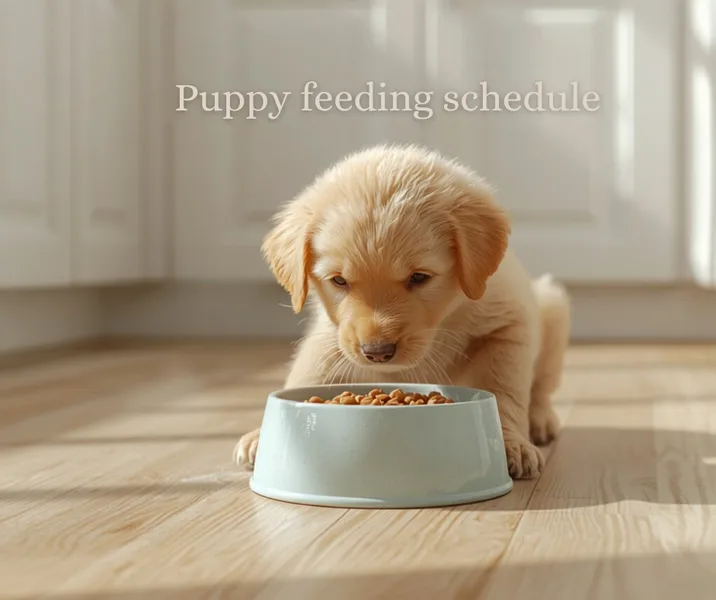
Establishing a consistent feeding schedule is one of the most important steps in taking care of a puppy.Puppy Feeding Guide — What, When, and How Much
Correct nutrition is the foundation of taking care of a puppy properly. Puppies have very different nutritional needs from adult dogs — they are growing rapidly and require more protein, fat, calcium, and phosphorus per pound of body weight than adults.
Choose the Right Puppy Food
Always select a food labelled specifically for puppies or “all life stages” — adult dog food does not contain the right nutrient balance for a growing puppy. Look for food where the first ingredient is a named protein source (chicken, beef, salmon) — not a by-product or filler. For large breeds (expected adult weight over 25kg), choose a large breed puppy formula specifically — these have a controlled calcium-to-phosphorus ratio that prevents the rapid bone growth associated with joint problems in large dogs.
Puppy Feeding Schedule by Age
8–12 Weeks4×meals per day
3–6 Months3×meals per day
6–12 Months2×meals per day
12+ Months2×adult schedule
Always follow the feeding guidelines on your specific puppy food packaging — these are calibrated to the caloric density of that food and your puppy’s expected adult weight. Use the guidelines as a starting point and adjust based on your puppy’s body condition — you should be able to feel their ribs without pressing hard, but not see them visibly.
🚫 Foods Toxic to Puppies — Never Feed These
Chocolate, coffee, and caffeine (theobromine toxicity)
Grapes and raisins (kidney failure — even small amounts)
Onions, garlic, and chives (damage red blood cells)
Xylitol — artificial sweetener in peanut butter, gum, yogurt (life-threatening)
Macadamia nuts (neurological symptoms)
Alcohol in any form
Avocado (persin toxicity)
Cooked bones (splinter and cause internal lacerations)
Puppy Vaccination Schedule — USA 2026
Vaccinations are one of the most important aspects of taking care of a puppy in their first year. According to the American Veterinary Medical Association (AVMA), core vaccines protect puppies against life-threatening diseases that are widespread and easily preventable with timely immunization.
Your veterinarian will determine the exact schedule based on your puppy’s age, weight, breed, lifestyle, and local disease prevalence. The vaccination schedule above is a general USA guideline — always follow your specific vet’s recommendations. Do not skip or significantly delay vaccines — the protection window is time-sensitive during the first months of a puppy’s life.
Potty Training Your Puppy — The Complete Method
Potty training is one of the most searched-for topics in puppy care — and one of the most achievable with the right approach. Most puppies can be reliably potty trained within 4–6 months with consistent positive reinforcement. The ASPCA confirms that positive reinforcement — rewards for correct behavior rather than punishment for accidents — is the most effective and humane potty training method.
The Core Potty Training Principle
Young puppies have very limited bladder control — a 2-month-old puppy can only hold their bladder for approximately 2 hours. At 3 months, approximately 3 hours. As a general rule, a puppy can hold their bladder for one hour per month of age, to a maximum of 8 hours for adult dogs. Potty training success depends entirely on taking your puppy outside frequently enough that they never have an opportunity to go inside.
Potty Training Schedule
1
Take out immediately after waking
Carry your puppy directly outside the moment they wake up — morning, after naps, and after any period in the crate. Puppies almost always need to go within 5 minutes of waking.
2
Take out after every meal
The digestive process in puppies is rapid — take your puppy outside within 15–20 minutes of every meal. Consistency at meal times dramatically accelerates potty training progress.
3
Take out every 1–2 hours during the day
Set a timer. For 8–12 week old puppies, go outside every 60–90 minutes during waking hours — regardless of whether your puppy is showing signs of needing to go.
4
Reward immediately — outside
The moment your puppy finishes going to the toilet outside, give enthusiastic verbal praise and a treat immediately — before re-entering the house. The reward must happen within 2 seconds of the behavior to create the correct association.
5
Handle accidents calmly
Never punish a puppy for having an accident — they cannot connect your reaction to something that happened more than 2 seconds ago. Clean accidents thoroughly with an enzymatic cleaner (not ammonia-based) to eliminate scent markers that attract puppies to re-use the same spot.
✅ Crate Training Tip: A correctly sized crate — just large enough for your puppy to stand, turn, and lie down — is the most powerful potty training tool available. Dogs instinctively avoid soiling their sleeping area. Use the crate for overnight sleep and short daytime periods, and take your puppy outside immediately every time they come out of the crate. Never use the crate as punishment.
Puppy Socialization — The Most Critical Window in Your Puppy’s Life
Of all the responsibilities involved in taking care of a puppy, socialization during the critical development window is the single most impactful thing you can do for your dog’s long-term wellbeing. The primary socialization window runs from approximately 3 to 16 weeks of age — and the experiences (or lack of them) during this period have lifelong consequences.
Puppies that are not adequately socialized during this window are significantly more likely to develop fear, anxiety, and reactive behaviors as adults — the behavioral problems most commonly associated with surrendered and rehomed dogs. According to the AKC’s socialization guidelines, “undersocialization is one of the most common and serious problems in pet dogs in the United States.”
What to Socialize Your Puppy To
The goal of puppy socialization is to expose your puppy to as wide a variety of people, animals, sounds, surfaces, and environments as possible — in a positive, controlled way — during the critical window. Key exposure categories include:
People: Men, women, children, elderly people, people wearing hats/sunglasses/uniforms, people using wheelchairs or walking aids
Animals: Other vaccinated dogs and puppies, cats (if safe), livestock (if relevant to your environment)
Handling: Having paws, ears, mouths, and tails touched — essential for future vet visits and grooming
Environments: Cars, pet stores, parks, stairs, elevators, urban and rural settings
🐾 Important Note on Socialization Before Full Vaccination
The socialization window (8–16 weeks) overlaps with the vaccination schedule. The American Veterinary Society of Animal Behavior states that the benefits of socialization significantly outweigh the risks of disease exposure when done carefully. Carry your puppy in arms to expose them to sounds and sights before they are fully vaccinated. Arrange playdates with vaccinated, healthy dogs. Puppy socialization classes with health-screened attendees are generally considered safe from 7–8 weeks by most veterinarians.
Puppy Sleep — How Much is Normal?
New puppy owners are frequently alarmed by how much their puppy sleeps — and equally alarmed when they are awake and seemingly relentlessly energetic. Both are completely normal. Understanding your puppy’s sleep needs is an important part of taking care of a puppy effectively.
8–10 Weeks18–20hours per day
10–14 Weeks16–18hours per day
3–6 Months14–16hours per day
6–12 Months12–14hours per day
Puppies sleep so much because their brains and bodies are developing at an extraordinary rate — sleep is when growth hormone is released and when experiences from the day are processed and stored. Never disturb a sleeping puppy unnecessarily — adequate sleep is as important for a puppy’s development as nutrition and socialization.
Setting up your puppy’s sleep space: Place the crate in your bedroom for the first few weeks — puppies that can hear and smell their owner settle significantly faster at night than those in a separate room. Put a warm (not hot) water bottle wrapped in a towel in the crate to replicate the warmth of littermates, and play soft background noise to mask sudden sounds that might startle them awake.
Basic Puppy Training — Commands to Start in Week One
The most common myth about taking care of a puppy is that training should wait until the puppy is older. In fact, training begins from Day 1 — every interaction with your puppy teaches them something about how the world works and what behaviors are rewarded. Starting basic command training in the first week establishes good habits, builds communication between you and your puppy, and tires them out mentally in a productive way.
5 Essential Commands to Teach First
1
Sit — The Foundation Command
Hold a treat close to your puppy’s nose, then slowly raise it above their head. Their bottom naturally lowers to the floor. The moment it touches, say “Sit” and reward immediately. Practice in 2-minute sessions, 3–5 times per day. Most puppies learn this within 48 hours.
2
Stay — Impulse Control
Ask your puppy to sit, then slowly take one step back. Return and reward before they move. Gradually increase the number of steps and duration. Stay teaches your puppy to control their impulses — one of the most valuable life skills a dog can have.
3
Come — The Safety Command
Crouch down to your puppy’s level, open your arms, and call their name followed by “Come!” in an excited, happy voice. Reward enthusiastically when they reach you. Never call your puppy to you for something they find unpleasant — this teaches them not to come. Always make “Come” the best thing that can happen.
4
Leave It — Safety and Impulse Control
Place a treat in your closed fist. When your puppy sniffs and licks at it, say “Leave it” calmly. The moment they stop trying and look away, reward with a different treat from your other hand. Advance to treats on the floor. This command can save your dog’s life — preventing them from picking up toxic objects on walks.
5
Name Recognition — Communication Foundation
Say your puppy’s name in a happy tone. The moment they look at you, reward and praise. Repeat throughout the day. Reliable name recognition — your puppy reliably looking at you when you call their name — is the foundation of all future communication and training.
Complete New Puppy Supplies Checklist
Having the right supplies ready before your puppy arrives makes the first days of taking care of a puppy significantly smoother. Here is a complete checklist organized by category:
🍽️ Feeding
High-quality puppy food (breed-appropriate)
Stainless steel or ceramic food bowl
Stainless steel or ceramic water bowl
Slow feeder bowl (optional but recommended)
Measuring cup for consistent portions
🛏️ Sleep & Comfort
Appropriately sized crate (just big enough to turn)
Crate liner or washable bed pad
Soft plush toy or blanket from breeder/shelter
Puppy-safe bed for outside the crate
🦺 Walking & Safety
Well-fitting puppy harness (not collar for walks)
4–6 foot training leash
ID tag with your phone number
Microchipping (scheduled at first vet visit)
Baby gates for staircases and rooms
🎾 Play & Training
Chew toys (appropriate for puppy teeth)
Interactive puzzle toy (beginner level)
Tug toy for bonding play
High-value training treats (small, soft)
Treat pouch for training sessions
🛁 Grooming
Puppy-specific shampoo
Soft bristle brush for coat type
Nail grinder (start acclimating early)
Dog toothbrush and puppy toothpaste
Ear cleaning solution
🧹 Cleaning
Enzymatic cleaner for accidents (essential)
Poop bags (biodegradable)
Puppy pads (optional — for overnight)
Lint roller for furniture and clothing
🐶
Premium Puppy Products at Arbsbuy
Harnesses, puzzle toys, water bottles, slow feeders, grooming tools & expert dog care ebooks — everything you need for your new puppy, shipped free from our USA warehouse.
For comprehensive guidance on choosing your puppy’s first harness — one of the most important equipment decisions for safe, comfortable walks — read our complete How to Choose a Dog Harness guide. For expert guidance on home grooming your dog from puppyhood, our Dog Grooming at Home guide covers everything you need.
For the most comprehensive single resource on dog health, care, and training for new owners, our expert-written Dog Health & Care Complete Guide ebook covers everything from puppy nutrition and vaccinations to adult dog health maintenance, behavioral training, and preventive healthcare — 130+ pages, instant download worldwide for $9.99.
Frequently Asked Questions About Taking Care of a Puppy
❓ When can I bring my puppy home?
Puppies should remain with their mother and littermates until at least 8 weeks of age — and ideally 10–12 weeks for most breeds. The socialization and behavioral development that occurs with the mother and siblings during weeks 6–8 is irreplaceable. Puppies removed before 8 weeks consistently show higher rates of behavioral problems, anxiety, and aggression as adults. Reputable breeders and shelters will not release puppies before the 8-week minimum.
❓ How long does it take to potty train a puppy?
With consistent positive reinforcement and a strict potty schedule, most puppies are reliably trained within 4–6 months. Some toy breeds can take up to 12 months due to smaller bladder capacity. The key variables are consistency (every time, every trip outside), positive reinforcement (treat immediately after going outside), and management (supervision and crate use to prevent accidents inside). Inconsistency is the most common reason potty training takes longer than expected.
❓ How do I stop my puppy from biting?
Puppy biting — also called mouthing — is entirely normal behavior. Puppies explore the world with their mouths and play by biting with littermates. The goal is not to stop all mouthing immediately but to teach “bite inhibition” — gradually reducing the pressure of bites until your puppy mouths very gently. When your puppy bites too hard, yelp sharply (mimicking a littermate’s response), immediately stop play and withdraw attention for 20–30 seconds, then resume. Redirect biting onto appropriate chew toys. Never use physical punishment — it increases anxiety and aggression.
❓ What should I expect on my puppy’s first night?
Most puppies cry on their first night away from their mother and littermates — this is completely normal and expected. To minimize distress: keep the crate in your bedroom so your puppy can hear and smell you; put a warm (not hot) water bottle and a ticking clock in the crate to replicate the warmth and heartbeat of littermates; place a t-shirt or item with your scent in the crate. Expect waking for a toilet trip every 3–4 hours for the first few weeks. Avoid going to your puppy every time they whimper — calm crying that does not escalate should be allowed to settle.
❓ How much exercise does a puppy need?
The general rule for puppy exercise is 5 minutes per month of age, twice per day. An 8-week-old puppy needs approximately 2 x 10-minute walks per day. A 4-month-old puppy needs 2 x 20-minute walks. Over-exercising growing puppies — particularly large breeds — stresses developing joints and growth plates and significantly increases the risk of joint problems later in life. Short, frequent outings are far better than one long walk. Indoor play, training sessions, and mental enrichment with toys count toward daily activity and are generally safer for young puppies.
❓ Should puppies wear a collar or harness?
For walks and leash training, a well-fitted harness is strongly recommended over a collar for puppies. Puppy necks are fragile and their bones are still developing — collar pressure during pulling or lunging can cause tracheal damage and neck injuries. A harness distributes pressure across the chest and shoulders, which are better able to handle it. Keep a collar for ID tags, but attach the leash to a harness for all walking. Read our complete guide on how to choose the right dog harness for your puppy’s size and breed.
❓ When do puppies calm down?
Most dogs begin to calm down noticeably between 12 and 18 months of age, as they transition from puppyhood into young adulthood. High-energy breeds (Border Collies, Australian Shepherds, Huskies, Vizslas) may not fully settle until 2–3 years. The best strategy for managing puppy energy is adequate physical exercise, daily mental stimulation with training and interactive toys, and consistent routine. A puppy that is physically and mentally satisfied is a significantly calmer puppy.
Final Thoughts — Taking Care of a Puppy
Taking care of a puppy in their first year is simultaneously the most challenging and most rewarding experience in dog ownership. The foundation you lay in these first months — through proper nutrition, timely veterinary care, consistent positive training, thorough socialization, and patient potty training — determines who your dog becomes for the next decade or more.
The most important things to remember:
First vet visit within 48–72 hours of bringing your puppy home
Socialization from Day 1 — the 8–16 week window is irreplaceable
Potty training starts immediately — consistency and positive reinforcement only
Training from Day 1 — sit, stay, come, leave it, and name recognition first
Harness over collar for all walks with a young puppy
Plenty of sleep — 16–20 hours per day for young puppies is normal and necessary
Patience above all — your puppy is doing the best they can in an overwhelming new world
For a complete resource that covers every aspect of dog health, care, training, and nutrition from puppyhood through adult life, our expert-written Dog Health & Care Complete Guide is available for instant download worldwide. For all the premium puppy and dog supplies you need — harnesses, puzzle toys, water bottles, and more — browse our complete dog products collection at Arbsbuy with free USA shipping from our U.S. warehouse and a 30-day money-back guarantee on every order.
📚
Dog Health & Care Complete Guide — Instant Download
130+ pages · Expert-written · Puppy through adult · Nutrition, training, health & grooming · PDF download worldwide · Just $9.99