
⚡ Quick Answer
To choose the right dog harness: for dogs that pull, use a front-clip harness (chest attachment point) — it physically redirects the dog toward you when they pull, without any neck pressure. For well-behaved dogs, a comfortable back-clip harness works. For small breeds and flat-faced dogs (French Bulldog, Pug, Cavalier King Charles Spaniel), always use a harness instead of a collar for walking — these breeds are particularly vulnerable to tracheal collapse and eye injury from collar pressure. To size: measure chest girth (around the deepest point behind the front legs) and size up when between sizes.
💡 Expert Tip
After fitting any harness, perform the two-finger test under every strap. Two fingers should slide comfortably under each strap — if you cannot fit two fingers, the harness is too tight and will restrict movement or cause pressure sores with extended wear. The front panel should rest on the breastbone and should never cross the point of the shoulder (the bony protrusion where the front leg meets the body) — crossing the shoulder joint restricts the natural gait and can cause long-term lameness.
📋 Table of Contents
- Why a Dog Harness Is Better Than a Collar
- 4 Main Types of Dog Harnesses Explained
- How to Measure Your Dog for a Harness
- Dog Harness Size Guide by Breed
- 7 Things to Look for When Choosing a Dog Harness
- Dog Harness vs Collar: When to Use Each
- Common Dog Harness Mistakes to Avoid
- How to Put On a Dog Harness Correctly
- Frequently Asked Questions
- Final Thoughts
If you have ever stood in a pet store — or scrolled through pages of dog harnesses online — and felt completely overwhelmed by the options, you are not alone. Knowing how to choose a dog harness is one of the most common questions dog owners ask, and the answer is not as simple as picking the one that looks good or costs the least. The wrong harness can restrict your dog’s movement, cause chafing, encourage pulling, or even allow your dog to escape — all serious problems that the right harness prevents from the start.
This guide breaks down everything you need to know about how to choose a dog harness — from understanding the different harness types to measuring your dog correctly, identifying the key quality features, and matching the right harness to your dog’s size, breed, and behavior. By the time you finish reading, you will know exactly what to look for and how to make a confident, informed decision.
🐾 Quick Answer
To choose a dog harness correctly, measure your dog’s chest girth first, then select a type (back-clip, front-clip, or dual-clip) based on how your dog walks. Look for adjustable straps, durable materials, and padded contact points. When between sizes, always choose the larger one for comfort and safety.
Why a Dog Harness Is Better Than a Collar
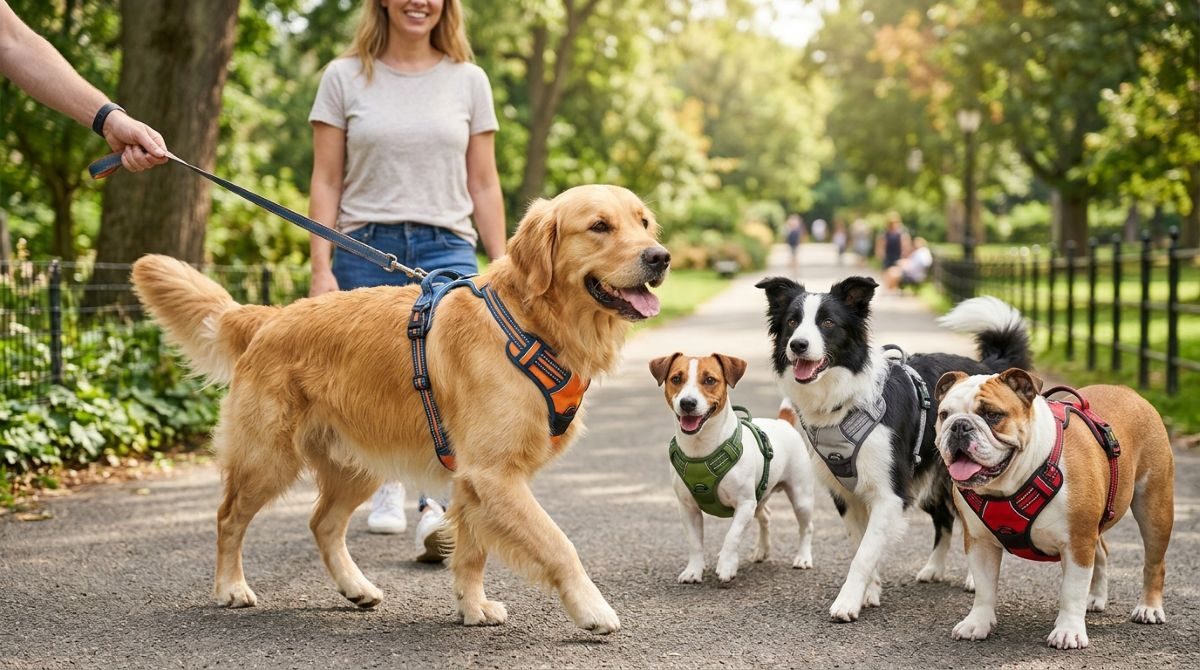
Before learning how to choose a dog harness, it helps to understand why a harness is the recommended walking tool for most dogs in the first place. The American Kennel Club (AKC) and most certified dog trainers agree that a dog harness distributes pressure more evenly across the chest and shoulders, unlike a collar which concentrates all force on the neck and throat.
This matters enormously for dog health. Dogs that pull on a collar repeatedly throughout their lives are at a significantly higher risk of tracheal damage, neck injuries, and even eye problems caused by increased intraocular pressure from collar tension. For dogs that are still learning to walk on a leash — or for breeds that pull naturally — a harness is not just more comfortable, it is genuinely safer.
Specific situations where a dog harness is strongly recommended include:
- Breeds with short, flat faces (brachycephalic breeds): Bulldogs, French Bulldogs, Pugs, Boston Terriers, and Shih Tzus have narrow airways that are easily compressed by collar pressure. A harness is essential for these breeds.
- Dogs that pull on the leash: A harness — particularly a front-clip or dual-clip design — gives you significantly more control over a pulling dog than a collar.
- Small and toy breeds: The neck of a small dog is fragile. Even moderate collar tension can cause serious injury. A harness protects these vulnerable areas entirely.
- Dogs recovering from neck or spinal injuries: A harness removes all pressure from the neck area during the recovery period.
- Puppies being trained to walk on a leash: Introducing a harness early builds positive associations and prevents the development of pulling habits before they start.
- Dogs with escape tendencies: A correctly fitted harness is far harder for a dog to back out of than a collar, making it the safer choice for dogs prone to slipping their lead.
“A harness is primarily about safety and control — not just style. For most dogs, especially those that pull, a harness is the single most impactful equipment upgrade an owner can make.”
— Leigh Siegfried, CPDT-KA, Certified Professional Dog Trainer
4 Main Types of Dog Harnesses Explained
The first and most important step in learning how to choose a dog harness is understanding the fundamental types available and what each one is designed for. Not every harness type suits every dog or every purpose.
1. Back-Clip Harnesses
Back-clip harnesses have the leash attachment ring positioned on the dog’s upper back. They are the most common type and work best for dogs that already have good leash manners and do not pull excessively. They are comfortable, easy to put on, and ideal for relaxed walking, hiking, and general outdoor activities.
Best for: Calm adult dogs, hiking and outdoor adventures, dogs trained not to pull.
Not ideal for: Strong pullers — back-clip designs can actually engage the dog’s natural opposition reflex and encourage more pulling.
2. Front-Clip (No-Pull) Harnesses
Front-clip harnesses have the leash ring on the dog’s chest. When a dog pulls forward, the leash tension causes them to pivot sideways — naturally interrupting the pulling motion and redirecting their attention back to you. These are widely used in dog training and are particularly effective for dogs in the early stages of leash training.
Best for: Dogs learning not to pull, reactive dogs, dogs in active training programs.
Not ideal for: Dogs with shoulder or front leg mobility issues. The chest ring can affect gait if the leash is kept taut consistently.
3. Dual-Clip (Multi-Function) Harnesses
Dual-clip harnesses combine front and back attachment points, giving owners the flexibility to use either depending on the situation. A front clip for active training walks, a back clip for relaxed outings — all in one harness.
Best for: Versatile everyday use, dogs in varying stages of training, owners who want one harness for multiple purposes.
4. Tactical / Military-Grade Harnesses
Tactical harnesses are built for durability, control, and function. Constructed from heavy-duty nylon with reinforced stitching and multiple adjustment points, they typically include a top handle for immediate control, MOLLE webbing for attaching accessories, and both front and back attachment points.
Best for: Large or strong dogs, working dog roles, outdoor adventures, owners who need maximum control and durability.
Arbsbuy Tactical Dog Harness — No-Pull, Military-Grade
Dual attachment points, top handle for instant control, heavy-duty nylon construction, fully adjustable. Available in 4 sizes. Free USA shipping.
How to Measure Your Dog for a Harness (Step by Step)
Knowing how to choose a dog harness in the right size is critical. A harness that is too tight causes discomfort and restricts movement. Too loose, and your dog can slip out — a genuine safety risk. Always measure before you order. You will need a soft fabric measuring tape and a few minutes with a calm, standing dog.
Measure Chest Girth — The Most Important Measurement
Have your dog stand naturally on all four paws. Wrap the measuring tape around the widest part of their chest — typically just behind the front legs and around the rib cage. This is the single most important measurement for harness sizing. Record this number in both inches and centimeters.
Measure Neck Girth
Measure around the base of your dog’s neck — at the point where a collar would normally sit. This measurement affects where the harness sits on the neck and whether the neck opening will be comfortable. Add two finger widths to this measurement for a comfortable fit.
Measure Body Length (for step-in harnesses)
Measure from the base of the neck to the base of the tail along the spine. This measurement is particularly important for step-in harnesses and vest-style designs where the harness covers more of the dog’s body.
Check the Two-Finger Rule
After fitting the harness, slide two fingers underneath any strap. If you cannot fit two fingers, the harness is too tight. If you can fit more than two fingers easily, it is too loose. This simple check applies to every strap on the harness.
✅ Pro Tip: If your dog’s measurements fall between two sizes on the sizing chart, always choose the larger size. A slightly larger harness can be adjusted to fit securely. A harness that is too small cannot be made larger and will cause discomfort or injury.
Dog Harness Size Guide by Breed
While individual measurements are always the most accurate method for choosing a dog harness, the following breed-by-size reference can help you identify a starting point. Use our full Arbsbuy Pet Size Guide for detailed measurement charts and breed-specific recommendations.
Small (XS–S) — Chest: 30–52cm
- Chihuahua
- Yorkshire Terrier
- Pomeranian
- Maltese
- Toy Poodle
- Papillon
Medium (M) — Chest: 52–70cm
- Beagle
- Cocker Spaniel
- Shiba Inu
- Bulldog
- Border Collie
- Shih Tzu
Large (L) — Chest: 70–90cm
- Labrador Retriever
- Golden Retriever
- Siberian Husky
- Doberman
- Standard Poodle
- Boxer
Extra Large (XL) — Chest: 90–110cm
- German Shepherd
- Rottweiler
- Alaskan Malamute
- Great Dane
- Saint Bernard
- Bernese Mountain Dog
Important note: These are general guidelines only. Dogs of the same breed can have very different body proportions. Always measure your specific dog — particularly their chest girth — before ordering. Do not rely on breed alone to determine harness size.
7 Things to Look for When Choosing a Dog Harness
Now that you understand the types and sizing, here are the seven most important quality factors to evaluate when learning how to choose a dog harness that will last and perform well.
1. Multiple Adjustment Points
A quality dog harness should have at least two — and ideally three or more — adjustment points. Being able to adjust both the neck girth and the chest girth independently allows you to achieve a truly custom fit on your specific dog. Generic harnesses with only one adjustment point rarely fit well across all body types.
2. Padded Chest and Underarm Panels
The areas where the harness makes contact with your dog’s skin — particularly around the chest and under the front legs (armpits) — should be padded with a soft, breathable material. Unpadded harnesses cause chafing and skin irritation, particularly on dogs who wear the harness for extended periods.
3. Durable, High-Quality Materials
Look for harnesses made from heavy-duty nylon webbing, ripstop fabric, or ballistic nylon for working dogs. The hardware — buckles, D-rings, and adjustment sliders — should be made from robust metal or high-grade reinforced plastic. Cheap plastic hardware fails under pressure and can cause your dog to escape suddenly.
4. Reflective Stitching or Strips
Reflective elements are a non-negotiable safety feature if you ever walk your dog in low-light conditions — early mornings, evenings, or overcast days. Reflective stitching dramatically increases your dog’s visibility to traffic and cyclists. Many quality harnesses include reflective strips as a standard feature.
5. Top Handle for Emergency Control
A top handle — a short grab handle positioned on the back of the harness above the dog’s shoulders — is an invaluable safety feature. It allows you to quickly take direct control of your dog in an emergency: pulling them away from traffic, lifting them over an obstacle, or restraining them in an unexpected situation.
6. Escape-Proof Design
Some dogs — particularly anxious dogs or those with narrow heads relative to their neck — are skilled escape artists who can back out of a loosely fitted harness. Look for harnesses with a secure chest strap that prevents backward escape, or consider a step-in harness style which wraps around the dog’s body in a way that makes slipping out much more difficult.
7. Easy On and Off
A harness that is difficult to put on will not get used consistently — especially if your dog is energetic or impatient. Look for harnesses with clear buckle systems and a logical structure that you can put on your dog in under thirty seconds once you are familiar with it. Step-in styles tend to be the easiest; overhead slip-on styles can be tricky for dogs that dislike things going over their head.
Dog Harness vs Collar: When to Use Each
Part of knowing how to choose a dog harness is also knowing when a collar might still be appropriate — and when a harness is non-negotiable.
| Situation | Collar | Harness |
|---|---|---|
| Everyday leash walking | Acceptable for calm, trained dogs | ✅ Recommended for most dogs |
| Dog that pulls | ❌ Risk of neck injury | ✅ Essential — front or dual clip |
| Brachycephalic breeds | ❌ Dangerous — airway compression | ✅ Required |
| Puppies (under 6 months) | ✅ For ID tags only | ✅ For all walks |
| ID tags and identification | ✅ Standard use | Supplement, not replace |
| Training sessions | ❌ Limited control | ✅ Better control and guidance |
| Car travel | ❌ Not safe for restraint | ✅ Connects to seatbelt clip |
| Dogs recovering from neck injury | ❌ Must be avoided | ✅ Essential |
The ASPCA recommends that dogs always wear an ID collar for identification purposes — but walks and exercise should ideally be conducted with a properly fitted harness attached to the leash, not the collar, for maximum safety and comfort.
Common Dog Harness Mistakes to Avoid
Even experienced dog owners make these mistakes when choosing and fitting a dog harness. Knowing what to avoid is just as important as knowing what to look for.
- Guessing the size by breed alone: Dog sizes vary enormously within breeds. A large Labrador and a small Labrador may need harnesses two sizes apart. Always measure.
- Not checking the fit after every wash: Materials can shrink slightly after washing, and fitting changes as your dog’s weight changes. Recheck the two-finger rule after every wash and after any significant weight change.
- Leaving the harness on 24/7: Harnesses are walking tools, not permanent accessories. Leaving a harness on your dog continuously can cause skin irritation, matting in long-coated breeds, and pressure sores. Remove the harness when indoors and at rest.
- Choosing a harness based on looks alone: A beautiful harness that does not fit well or lacks key safety features is useless — and potentially harmful. Prioritize function and fit above aesthetics.
- Using a front-clip harness without a trainer’s guidance: Front-clip harnesses are excellent training tools, but used incorrectly they can affect your dog’s gait. If your dog has joint or mobility issues, consult a veterinarian or certified trainer before using a front-clip design.
- Buying the cheapest option available: A harness is a safety device. Hardware failures and cheap materials can result in your dog escaping into traffic or sustaining injury. Invest in a quality harness — it is one of the most important things you buy for your dog’s safety.
How to Put On a Dog Harness Correctly
Even the best harness is useless if it is put on incorrectly. The fitting process depends on the harness type:
For an Overhead/Slip-On Harness:
- Hold the harness open and slip it over your dog’s head, positioning the logo or chest panel on the front of their chest
- Guide your dog’s front legs through the leg holes one at a time
- Bring the back panel up over the dog’s back and click the side buckles
- Adjust all straps until snug and check the two-finger rule on each strap
- Attach the leash to the appropriate D-ring for your walking purpose
For a Step-In Harness:
- Lay the harness flat on the floor in the shape of a figure-eight
- Have your dog step one paw into each loop
- Pick up both sides of the harness and clip the buckle on your dog’s back
- Adjust the straps and verify the two-finger rule throughout
💡 Making Harness Time Positive
If your dog is reluctant to wear a harness, introduce it gradually. Let them sniff it first, then reward calmly with treats while draping it over their back without fastening. Over several sessions, work up to full fitting. Positive associations make harness time stress-free for both of you.
Frequently Asked Questions About Dog Harnesses
Final Thoughts — Choosing the Right Dog Harness
Learning how to choose a dog harness comes down to four essentials: understanding the types available, measuring your dog accurately, knowing what quality features to look for, and matching the harness to your specific dog’s needs and behavior.
To recap the most important points:
- Measure chest girth first — it is the single most critical measurement
- Choose back-clip for calm dogs, front-clip or dual-clip for pullers
- Look for padded panels, multiple adjustment points, reflective elements, and quality hardware
- Apply the two-finger rule to every strap after fitting
- When between sizes, always choose the larger option
- Remove the harness when your dog is resting indoors
A well-chosen dog harness makes every walk safer, more comfortable, and more enjoyable — for both you and your dog. It is one of the most impactful investments you can make in your dog’s daily wellbeing and long-term health.
For detailed size charts, breed-specific recommendations, and measurement guidance, visit the Arbsbuy Pet Size Guide. To explore our full range of premium dog products — including our top-rated tactical dog harness — browse the Arbsbuy dog products collection with free USA shipping on every order.
For deeper reading on dog care, health, and training, our Dog Health & Care Complete Guide covers everything from harness training to nutrition, exercise, and preventative healthcare for dogs of every breed and age.
Shop Premium Dog Harnesses at Arbsbuy
Free USA shipping · 30-day money-back guarantee · Ships from our U.S. warehouse · Multiple sizes available
Sources: American Kennel Club — Choosing the Right Dog Harness | ASPCA — Dog Care Guide | PetMD — Harness vs Collar
📄 Sources & References
- Journal of Veterinary Behavior (2017): Harness vs collar during leash walking — harness reduces tracheal pressure by up to 91% during pulling — https://www.journalvetbehavior.com
- Applied Animal Behaviour Science (2019): Leash equipment and dog stress response — harness shows lower cortisol than collar in pullers — https://www.sciencedirect.com/journal/applied-animal-behaviour-science
- AKC: Dog Harness Guide — types, fitting and breed-specific recommendations — https://www.akc.org/expert-advice/dog-care/dog-harness
- AVMA: Dog Walking Safety — proper equipment recommendations for owners — https://www.avma.org/resources-tools/pet-owners/petcare/walking-your-dog