
⚡ Quick Answer
Dog separation anxiety is a genuine panic response — not disobedience. Treatment combines two things: desensitisation training (teaching the dog to tolerate increasing alone-time in tiny, gradual increments starting from seconds, not minutes) and in moderate-to-severe cases, anti-anxiety medication from a vet. Never punish destruction caused by separation anxiety — punishment applied after the fact increases the dog’s anxiety and always makes the behaviour worse.
💡 Expert Tip
Video your dog in the first 30 minutes after you leave home before your vet appointment. Most separation anxiety occurs within 5 minutes of departure. The video shows your vet exactly what is happening (barking, pacing, destruction, elimination) and is far more diagnostic than a verbal description — and it often confirms whether the problem is true separation anxiety or a different issue altogether.
📋 Table of Contents
- What Is Dog Separation Anxiety? Not Just Bad Behavior
- 10 Warning Signs Your Dog Has Separation Anxiety
- Separation Anxiety vs Boredom — Key Differences
- 5 Root Causes of Dog Separation Anxiety
- 8 Proven Solutions That Actually Help
- How to Document Your Dog’s Behavior for Your Vet
- Dog Breeds Most Prone to Separation Anxiety
- Frequently Asked Questions
- Final Thoughts
You leave for work in the morning, and something breaks inside your dog. The barking starts before you reach the elevator. By the time you return home eight hours later, a cushion has been destroyed, the hallway carpet is scratched through, and there is evidence that your normally well-trained dog could not hold their bladder. If this scenario is familiar, your dog may be experiencing dog separation anxiety — and it is one of the most misunderstood behavioral conditions in pet dogs today.
Dog separation anxiety is not stubbornness, spite, or “bad behavior.” It is a genuine, physiological fear response — the same kind of panic a person experiences in a true emergency — triggered by the simple act of being left alone. Your dog is not destroying your belongings to punish you for leaving. They are in a state of escalating distress that they have no ability to regulate, and the destructive behavior is a symptom of that panic, not its cause.
Approximately one in four dogs will experience separation anxiety at some point in their lives. Understanding the signs of dog separation anxiety, why it happens, and what actually works to help — that is the purpose of this complete guide. Whether you are dealing with a mild case or a severe one, the information and solutions here give you a clear, actionable path forward.
🐾 Quick Answer
Dog separation anxiety affects an estimated 17–20% of the dog population and is one of the most misunderstood behavioral conditions in pets. The most common dog separation anxiety signs are excessive vocalization (barking, howling, whining) within minutes of your departure, destructive behavior focused on exits (doors, windows), house soiling despite being housetrained, and frantic greeting behavior when you return. The most effective solutions combine pre-departure enrichment (puzzle toys, frozen treats), gradual desensitization training, daily exercise, and in moderate-to-severe cases, veterinary consultation.
What Is Dog Separation Anxiety? Not Just Bad Behavior
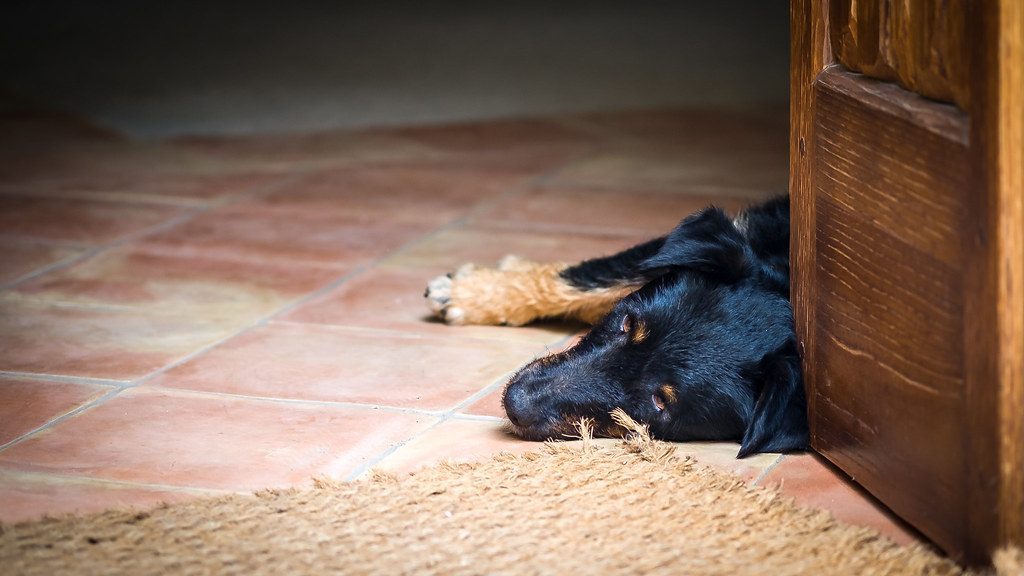
Dog separation anxiety is a behavioral disorder characterized by extreme distress when a dog is separated from their primary attachment figure — typically their owner or a specific family member. Unlike boredom or under-stimulation, which produce casual destructive behavior, separation anxiety produces a full physiological stress response: elevated heart rate, increased cortisol levels, and a nervous system that interprets the owner’s absence as a genuine threat to survival.
This distinction matters enormously for how you respond. Correcting or punishing a dog for separation anxiety behavior — however understandable the frustration — does not work and makes the condition significantly worse. The dog is not making a choice to be destructive; they are in a state of genuine panic that needs to be addressed through desensitization, enrichment, and in severe cases, veterinary behavioral support.
10 Warning Signs Your Dog Has Separation Anxiety
Recognising dog separation anxiety signs early makes treatment significantly more effective. The sooner you identify the problem, the easier the solution.
The defining characteristic of true dog separation anxiety signs is that they occur specifically when the dog is alone or separated from their attachment figure — not throughout the day. A dog that destroys things when bored but is calm when their owner is home and calm is probably not experiencing separation anxiety. A dog that exhibits these signs exclusively or primarily when left alone almost certainly is.
Excessive Vocalization
Persistent barking, howling, or whining that starts within minutes of departure and may continue for hours. Neighbors often report this before the owner is even aware it is happening.
Destructive Behavior at Exit Points
Chewing, scratching, or digging specifically at doors, windows, and other exit points — not random chewing throughout the home. The dog is attempting to escape and find their owner.
House Soiling Despite Training
Urinating or defecating indoors despite being completely housetrained. The dog loses bladder or bowel control due to the intensity of the anxiety response.
Pacing and Restlessness
Repetitive, purposeless movement along a fixed path — pacing back and forth along the same route — that does not occur when the owner is home. A sign of unresolved stress energy.
Pre-Departure Anxiety
The dog begins showing distress before the owner even leaves — triggered by departure cues like putting on shoes, picking up keys, or putting on a coat. Some dogs begin panting and pacing 30–60 minutes before departure.
Excessive Drooling and Panting
Physiological stress responses that appear specifically around departures or during alone time. Excessive salivation that is not related to food or temperature is a clinical sign of acute anxiety.
🚨 Self-Injury in Escape Attempts
Dogs in severe separation panic may injure their teeth, nails, and paws attempting to escape through doors, crates, or windows. Any self-injury from separation anxiety is a veterinary emergency — seek professional help immediately.
Frantic Greeting Behavior
Hysterical, uncontrollable excitement when the owner returns — jumping, whining, urinating — that takes 10+ minutes to settle. While normal dogs greet enthusiastically, dogs with separation anxiety cannot regulate their reunion response.
Refusal to Eat When Alone
Dogs in acute anxiety cannot engage the digestive system — the stress response physiologically suppresses appetite. A dog that refuses food left during the day despite being healthy and food-motivated may be experiencing significant alone-time anxiety.
Excessive Shadowing When Home
“Velcro dog” behavior — following the owner from room to room, being unable to settle alone in any room, and showing distress at any micro-separation (even when the owner enters a different room). A key indicator of hyper-attachment that underlies separation anxiety.
⚠️ Important
Many of these dog separation anxiety signs can also be symptoms of medical conditions — pain, urinary tract infections, seizure disorders, thyroid problems, and gastrointestinal issues can all produce behaviors that mimic separation anxiety. Always rule out medical causes with a veterinary examination before pursuing behavioral treatment.
Separation Anxiety vs Boredom — Critical Differences
Not every dog that chews furniture when left alone has separation anxiety. Understanding the difference between true separation anxiety and boredom-driven behavior determines your entire treatment approach — because what helps boredom makes separation anxiety worse, and vice versa.
| Behavior | Dog Boredom | Dog Separation Anxiety |
|---|---|---|
| When it occurs | Throughout the day — even when owner is home but not engaging | Specifically and exclusively when alone or separated |
| Destructive target | Random objects throughout the home — furniture, shoes, trash | Specifically exits — doors, windows, fences |
| Eats when alone | Yes — usually eats food and treats left during the day | Often refuses food despite being hungry — anxiety suppresses appetite |
| Camera behavior | Explores home, naps, plays with available toys | Paces, pants, vocalizes persistently — cannot settle |
| Physical symptoms | No — boredom is cognitive, not physiological | Yes — panting, drooling, trembling, elevated heart rate |
| Treatment approach | More enrichment, exercise, interactive toys | Gradual desensitization + enrichment + possibly medication |
| Response to treats | Engages with treat-dispensing toys when alone | Often ignores high-value treats due to anxiety state |
5 Root Causes of Dog Separation Anxiety
Hyper-Attachment
Dogs that are constantly with their owners — sleeping in the same bed, working from home, never being left alone — develop an inability to cope with any separation. The dog never develops the coping mechanisms that come from positive experiences of being alone. This is among the most common causes in dogs adopted during COVID-19 remote working periods, who then experienced sudden schedule changes.
Genetic Predisposition and Breed
Some breeds are significantly more prone to separation anxiety than others — particularly those bred specifically for close human companionship or high-contact working roles. Border Collies, Vizslas, German Shorthaired Pointers, Jack Russells, and German Shepherds consistently appear in separation anxiety prevalence studies. However, any individual dog of any breed can develop the condition.
Major Life Changes
A sudden change in the dog’s routine or social environment — a new work schedule, moving to a new home, a family member leaving, the addition of a new pet, or even a change in the owner’s scent habits (new perfume, work clothes change) — can trigger or worsen separation anxiety signs in previously settled dogs. Dogs are creatures of extreme routine whose nervous systems react to disruption.
History of Abandonment or Rehoming
Dogs from shelters, rescues, or multiple rehomings are statistically more likely to develop separation anxiety — their previous experiences of abandonment create a genuine, deep-seated fear that the current owner will also disappear. This learned abandonment response is one of the most challenging to address and typically requires the most patient, gradual treatment approach.
Lack of Alone-Time Training in Puppyhood
Puppies that are never positively exposed to brief periods of alone time during the critical socialization window (8–16 weeks) do not develop the emotional skills to cope with separation as adults. See our complete guide on taking care of a puppy for early prevention strategies that build alone-time resilience from the start.
Post-Medical Event or Aging
Dogs that experience a traumatic veterinary procedure, serious illness, or significant pain event sometimes develop separation anxiety afterward — the vulnerability of illness creates new insecurity. Senior dogs may also develop anxiety symptoms as part of cognitive dysfunction syndrome (canine dementia), which disrupts their ability to process and cope with environmental stressors.
8 Proven Solutions to Help a Dog with Separation Anxiety
Understanding dog separation anxiety and its solutions is the first step to helping your dog live comfortably alone.
The single most impactful immediate intervention for dog separation anxiety is providing a high-value enrichment item 5 minutes before departure — and giving nothing upon return. A food-stuffed toy or frozen treat-filled Kong-style toy given just before you leave creates a powerful departure association: your leaving predicts something wonderful. The mental engagement of working the toy also interrupts the anxiety spiral that begins as soon as your dog notices departure cues.
The key is exclusivity — this item is only available when the dog is alone. It never appears at other times. This exclusivity maintains the strong association between “owner leaving” and “extraordinary treat.” Over time, many dogs begin looking forward to being left alone because of the reliable high-value reward that follows. Use frozen fillings (frozen peanut butter, frozen wet food, frozen yogurt with blueberries) for the longest possible engagement duration — typically 30–60 minutes for a well-stuffed frozen toy.
Implementation Protocol
- Fill a Kong-style toy or treat puzzle with high-value food and freeze overnight
- 5 minutes before departure, give the frozen toy to your dog in their safe space
- Leave without prolonged goodbye rituals — brief, calm, matter-of-fact departures
- Upon return, completely ignore your dog for 5–10 minutes until they are fully calm before greeting
- Remove and store the toy immediately on return — it is exclusively for alone time
Interactive Puzzle Toys — Perfect for Separation Anxiety
PETMARVEL puzzle toy · 3 difficulty levels · BPA-free · Dishwasher safe · Keeps dogs engaged 20–45 min · Free USA shipping · 30-day guarantee
Dogs with separation anxiety learn to recognize departure cues — specific actions that predict the owner is about to leave. These cues (picking up keys, putting on shoes, putting on a jacket) can trigger anxiety responses 30–60 minutes before the owner even leaves. The solution is to systematically break the association between these cues and departure by performing them repeatedly throughout the day without leaving.
Daily Desensitization Practice
- Pick up your keys — put them down. Give a treat. Resume your day.
- Put on your shoes — take them off. Give a treat. Resume your day.
- Put on your coat — take it off. Give a treat. Resume your day.
- Repeat each cue 5–10 times daily until your dog stops reacting to them
- Once individual cues are neutral, practice the full sequence: shoes, keys, coat — but do not leave
- Gradually introduce very brief actual departures: exit the front door, come back in 5 seconds. Treat calmly. Extend duration over weeks.
Thirty minutes of vigorous physical exercise immediately before departure is one of the most reliably effective interventions for reducing dog separation anxiety signs. The physiological mechanism is straightforward: exercise depletes excess stress hormones, reduces circulating cortisol, increases serotonin and dopamine, and produces physical tiredness that makes rest — rather than panicked pacing — the default response to being alone.
According to PetMD’s veterinary guidance, 30 minutes of moderate-to-vigorous exercise before departure can significantly reduce anxiety symptoms in most dogs. A morning run, fetch session, or brisk walk before work is one of the most practical and effective changes owners can implement immediately. Combine with pre-departure enrichment for maximum effect.
A designated, consistent safe space — a crate that the dog has been positively trained to love, or a specific room — reduces the environmental variables that anxious dogs find overwhelming. The predictability of the space itself is calming. Include the dog’s bed with an unwashed item of your clothing (your scent is profoundly calming to your dog), a treat-filled toy, and a white noise machine or radio playing classical music at low volume. Classical music has been shown in multiple veterinary studies to reduce stress indicators in dogs compared to silence or rock music.
Critically: the safe space must be introduced and conditioned as a positive, voluntary environment during times when the owner is home — not forced upon an already-anxious dog at departure. A dog shoved into a crate at the moment of departure experiences it as punishment, not comfort.
If your dog cannot be in a different room from you without distress, real-world absences will always be overwhelming. Begin practicing micro-separations while you are home: close the bathroom door, go to the garden alone, work in a room with a baby gate. Reward calm behavior through the barrier. Gradually extend the duration of these in-home separations until your dog can comfortably spend 20–30 minutes in a separate area from you while remaining calm. Only then begin extending actual departure absences.
This approach directly addresses the root cause of most dog separation anxiety — the inability to self-regulate in the absence of their attachment figure. Building this capacity at home, where the stakes are low, creates a foundation for coping with real departures.
Several evidence-based calming aids can support behavioral training — though none of them work as a standalone solution for true dog separation anxiety. Used in combination with desensitization training, they can meaningfully reduce baseline anxiety:
- Dog-Appeasing Pheromone (DAP/Adaptil): A synthetic version of the pheromone mother dogs produce during nursing. Available as diffusers, sprays, and collars. Multiple clinical studies show significant reduction in stress behaviors in dogs exposed to DAP.
- Pressure wraps (Thundershirt): Consistent, gentle pressure on the dog’s torso produces a calming effect similar to swaddling in human infants. Effective for approximately 80% of dogs with mild-to-moderate anxiety.
- Classical music: Specifically designed dog relaxation music (iCalmDog) or radio left on at low volume provides auditory predictability that reduces environmental startle responses.
- Calming supplements: L-theanine, melatonin, and valerian-based supplements show evidence of mild anxiety reduction. Always consult your veterinarian before adding any supplement to your dog’s routine.
For moderate to severe dog separation anxiety, working with a Certified Separation Anxiety Trainer (CSAT) is the highest-impact intervention available. CSATs specialize specifically in this condition and use structured desensitization protocols tailored to your dog’s specific triggers, threshold levels, and response patterns. Many CSATs offer remote consulting via video, making this accessible regardless of your location.
According to the ASPCA, working with a certified behaviorist produces significantly faster progress than self-directed training alone for dogs with moderate or severe separation anxiety. The investment in professional support typically results in faster resolution and fewer behavioral setbacks.
For dogs with moderate to severe separation anxiety signs that do not respond adequately to behavioral approaches alone, veterinary medication can be transformative. Two categories of medication are commonly used:
- Daily SSRIs (fluoxetine/Reconcile, sertraline): Antidepressants that lower overall baseline anxiety over 4–6 weeks of consistent use. Most effective when combined with behavioral modification training. FDA has approved fluoxetine specifically for canine separation anxiety.
- Situational anxiolytics (alprazolam, clonidine): Fast-acting medications given before a specific stressor — a departure that cannot be avoided during training. These are not long-term solutions but provide management during intensive training periods.
Medication is not a shortcut — it works best as a support to behavioral training, not a replacement for it. The goal is to lower the dog’s baseline anxiety enough that behavioral modification can take hold. Most dogs can eventually be tapered off medication as behavioral progress consolidates. Always work with your veterinarian — never attempt to medicate a dog with human anxiety medications.
How to Document Your Dog’s Behavior for Your Vet
When you consult a veterinarian about dog separation anxiety, video documentation of the actual behavior is far more valuable than a verbal description. Veterinarians and behaviorists cannot observe what happens when you leave — your description is filtered through interpretation and memory. Video is objective and complete.
- Set up a phone or security camera pointing at your dog’s main area before leaving. Many pet cameras (Furbo, Wyze) allow real-time monitoring and recording.
- Record the departure sequence: Your dog’s behavior as you put on shoes, pick up keys, exit the door, and the first 30 minutes after you leave.
- Record both crated and uncrated: Veterinarians need to see whether confining your dog in a crate changes the behavior — some dogs are worse in crates (crate aversion), others are calmer.
- Note the exact timing of when behaviors start, peak, and (if applicable) resolve after departure.
- Keep a behavior log: Note which days and times behaviors occur, their duration, severity, and any environmental factors that seemed to correlate.
Dog Breeds Most Prone to Separation Anxiety
Vizsla, Border Collie, Jack Russell Terrier
Bred for intense, constant human interaction. Extremely prone to anxiety when this contact is removed. Require significant enrichment and training from puppyhood.
German Shepherd, Labrador, Cocker Spaniel
Highly social, owner-focused breeds with strong attachment tendencies. More likely to develop anxiety after lifestyle changes or rehoming.
Golden Retriever, Poodle, Bichon Frisé
Social breeds that can develop anxiety — particularly Bichons, which were specifically bred as companion dogs for constant human presence.
Mixed Breeds, Rescue Dogs
Risk depends heavily on history. Rescue dogs and formerly stray dogs have higher-than-average rates of separation anxiety related to past abandonment experiences.
Basset Hound, Shiba Inu, Chow Chow
More independent breeds with less human-attachment dependency. Still capable of developing anxiety — particularly after major life changes — but statistically less common.
Any Breed Can Be Affected
Breed predisposition is a risk factor, not a guarantee. Any individual dog of any breed can develop separation anxiety given the right combination of genetics, history, and circumstances.
Frequently Asked Questions About Dog Separation Anxiety
Final Thoughts — Dog Separation Anxiety Signs and Solutions
Dog separation anxiety is one of the most distressing behavioral conditions a dog can experience — and one of the most commonly misunderstood. Understanding that the signs of dog separation anxiety represent genuine panic, not defiance or spite, fundamentally changes how you respond to the condition — and makes the treatment approach both clearer and more compassionate.
Managing dog separation anxiety requires patience and consistency — but the results are transformative for both dog and owner. The eight solutions outlined above — from pre-departure enrichment and departure cue desensitization to professional behavioral support and veterinary medication — represent a comprehensive toolkit that addresses separation anxiety at every level of severity. Start with the pre-departure enrichment and exercise interventions, which produce immediate results for many dogs. Add desensitization training for sustained progress. Seek professional support for moderate-to-severe cases, and consider veterinary consultation for any dog whose anxiety is causing physical harm or significant quality-of-life impact.
For a complete expert resource on dog behavior, training, and health management — including a dedicated section on anxiety management and building canine resilience — our Dog Health & Care Complete Guide ebook is available for instant download worldwide. For premium dog enrichment products including puzzle toys and interactive feeders that support separation anxiety management, visit Arbsbuy with free USA shipping from our U.S. warehouse.
Dog Health & Care Complete Guide — Instant Download
Expert dog behavior, training & health guide · Anxiety management chapter · 130+ pages · PDF worldwide · $9.99
Sources: ASPCA — Dog Separation Anxiety | American Kennel Club — Separation Anxiety Guide | PetMD — Dog Separation Anxiety | VCA Hospitals — Separation Anxiety Treatment
📄 Sources & References
- American College of Veterinary Behaviorists: Separation Anxiety in Dogs — clinical diagnostic criteria and 17% prevalence rate — https://www.dacvb.org
- Applied Animal Behaviour Science: Systematic desensitization combined with medication: 85% improvement in separation anxiety cases — https://www.ncbi.nlm.nih.gov/pmc/articles/PMC4253553/
- AVMA: Canine Separation Anxiety — behavioral modification and pharmacological treatment options — https://www.avma.org
- IAABC: Separation Anxiety Protocol Standards — certified consultant approach to desensitization — https://iaabc.org