
⚡ Quick Answer
Excessive meowing in cats has five common causes: hunger or anticipation of feeding (peaks around mealtimes), learned attention-seeking behaviour (the owner responded once and the cat learned it works), a medical issue (hyperthyroidism, high blood pressure, dental pain, and cognitive dysfunction all cause increased vocalisation), breed characteristics (Siamese, Burmese, and Oriental breeds are naturally high-vocal), and reproductive behaviour in unspayed/unneutered cats. A sudden increase in meowing — particularly in a cat over 8 years old — always requires a vet visit to rule out hyperthyroidism and hypertension.
💡 Expert Tip
Never respond to demand meowing with food, attention, or play — even once. One successful response teaches the cat that meowing long enough always works. Instead, wait for a brief pause in the meowing before giving attention, and introduce puzzle feeders to replace meal-time meowing with active foraging. Consistency in non-response is essential: inconsistent ignoring (sometimes you give in, sometimes you don’t) produces the most persistent meowing of all.
If you are wondering why is my cat meowing so much, you are not alone — excessive vocalization is one of the most common concerns among cat owners, and the answer is almost always one of a short list of identifiable causes.
📋 Table of Contents
- Why Cats Meow at Humans — A Fascinating Fact
- 10 Real Reasons Your Cat Is Meowing So Much
- The Meow Decoder — What Each Type Means
- When Excessive Meowing Is a Medical Emergency
- Night Meowing — A Special Section
- 8 Proven Strategies to Reduce Excessive Meowing
- Cat Breeds That Meow the Most (and Least)
- Frequently Asked Questions
- Final Thoughts
It is 2am. Your cat is sitting at your bedroom door producing a sound somewhere between a wail and a demand for immediate audience. Or perhaps it happens during dinner, or every time you sit down at your desk — a persistent, repetitive meow that seems to have no obvious cause and no obvious end. If you are asking yourself why your cat is meowing so much, you are in the right place.
Excessive cat meowing is one of the most common behavioral concerns cat owners bring to their veterinarians — and one of the most misunderstood. Most people assume excessive meowing means a demanding or difficult cat. In reality, a cat that is meowing excessively is communicating something specific — a need, a discomfort, a health concern, or an emotional state — and the behavior will not resolve until the underlying cause is identified and addressed.
This complete guide explores all ten real reasons cats meow excessively, gives you a unique meow-type decoder to help you understand what your cat is actually saying, and provides eight proven strategies to reduce unnecessary vocalization — while never ignoring the genuine communication your cat is trying to make.
🐱 Quick Answer
Cats meow excessively for 10 main reasons: hunger, attention-seeking, stress or anxiety, reproductive behavior (unspayed/unneutered), medical pain or discomfort, cognitive dysfunction in seniors, hyperthyroidism, hypertension, sensory decline (deafness), and learned behavior from being rewarded for meowing. Sudden dramatic increase in meowing always warrants a veterinary visit — it is one of the most reliable early indicators of health problems in cats.
Why Cats Meow at Humans — A Fascinating Fact First
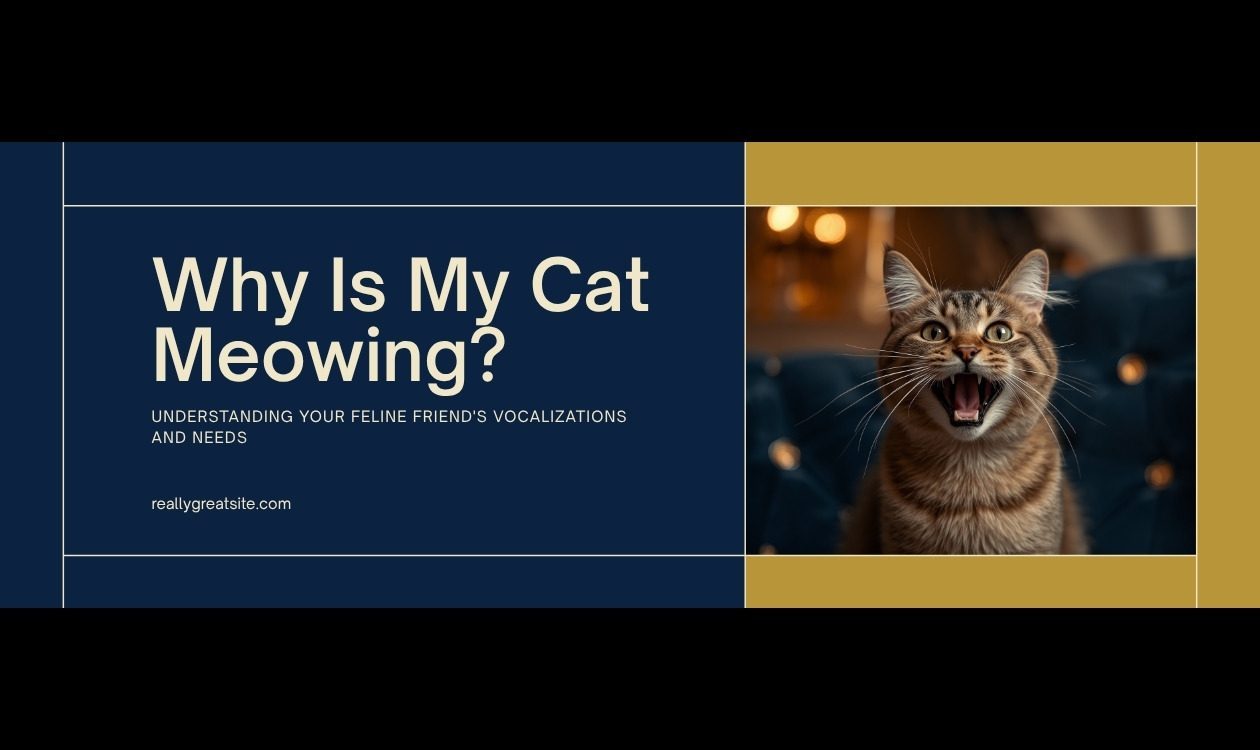
Research from animal behaviorists confirms that cats actually customize their meows for their individual owners — developing specific vocalizations that they learn will produce specific responses from that particular human. This means why your cat meows so much is not a generic question with a generic answer: it depends on what your cat has learned about what meowing achieves in your specific household.
10 Real Reasons Your Cat Is Meowing So Much
Hunger or Thirst — The Most Common Cause
The simplest explanation is often the correct one. Cats that meow persistently around mealtimes — or who intensify their meowing as mealtime approaches — have learned that vocalization produces food. This is conditioned behavior: at some point in this cat’s life, meowing was followed by food appearing, and the behavior was reinforced. Cats are extraordinarily quick learners — if meowing worked once, they will repeat it with increasing persistence and volume until it works again.
Check that your cat’s water bowl is filled, clean, and appealing. Many cats refuse to drink from still, stagnant water and will meow persistently due to thirst even when a water bowl is technically present. An automatic cat water fountain from Arbsbuy solves this problem by providing the continuously moving water that cats instinctively prefer — dramatically increasing daily hydration. For more on why cats avoid their water bowls, see our guide on why cats don’t drink water.
✅ Easily Resolved — Check Food and Water FirstAttention-Seeking — Your Cat Has Learned Meowing Works
Like hunger-driven meowing, attention-seeking meowing is a learned behavior. At some point, your cat meowed, you responded with attention (even negative attention — saying “shh!” or “stop it!” counts), and the cat learned that meowing is an effective tool for getting your focus. This is one of the most common causes of cats meowing so much — and it is owner-created, which means it is owner-solvable.
The key is understanding that any response — even a frustrated “stop meowing!” — reinforces the behavior. The only approach that works for attention-seeking meowing is consistent, complete non-response to meowing while consistently rewarding quiet behavior with the attention the cat seeks. This requires patience — the behavior will temporarily intensify before it reduces (an “extinction burst”) — but is highly effective over 2–4 weeks of consistent application.
✅ Behaviorally Manageable — Requires ConsistencyStress, Anxiety, or Environmental Change
Cats are profoundly sensitive to environmental change. A new person in the home, a house move, rearranged furniture, a new pet, a change in your work schedule, building work nearby — any significant change to a cat’s perceived territory or routine can trigger anxiety-driven vocalization. Unlike hunger or attention-seeking meowing, stress meowing is often accompanied by other anxiety indicators: hiding, reduced appetite, changes in litter box use, or overgrooming.
Stress-driven excessive meowing typically resolves once the cat adjusts to the new situation — usually within 1–3 weeks for minor changes and up to 2–3 months for major ones like home moves or new pets. During this adjustment period, maintaining maximum routine consistency, providing additional enrichment, and using calming aids (Feliway diffuser, calming treats with L-theanine) can help reduce vocalization.
⚠️ Monitor — Identify and Address the StressorReproductive Behavior — Unspayed/Unneutered Cats
If your cat is not spayed or neutered, reproductive drives are the most likely explanation for intense, persistent vocalization — particularly yowling that sounds distressed. Female cats in heat (estrus) produce extraordinarily loud, persistent calling behavior (the “heat cry”) that can occur every 2–3 weeks for days at a time. Male cats detecting a female in heat will similarly vocalize loudly and persistently. This is entirely instinct-driven and cannot be trained away — the only solution is spaying or neutering, which eliminates the reproductive vocalization completely.
✅ Resolved by Spay/Neuter — Book Your Vet AppointmentPain or Physical Discomfort
Cats instinctively mask pain — a survival instinct from their evolutionary history as both predator and prey. However, when pain reaches a threshold they cannot manage, vocalization often breaks through the suppression. A cat meowing more than usual — particularly if the meowing sounds different, more urgent, or more distressed than their normal communication — must be assessed for pain as a possible cause.
Common pain sources that drive excessive meowing in cats include dental disease (extremely prevalent — affecting over 70% of cats over 3 years old), arthritis, urinary tract infections or blockages, and abdominal pain from digestive issues. Urinary blockages in male cats are life-threatening emergencies — a male cat straining in the litter box while meowing urgently requires immediate veterinary care. Keep a simple journal noting when the meowing intensifies and under what conditions — this information significantly helps your vet’s diagnosis.
🚨 Seek Veterinary Evaluation — Do Not DelayHyperthyroidism — The Most Common Medical Cause in Senior Cats
Hyperthyroidism — overproduction of thyroid hormone — is the single most common endocrine disorder in cats over 10 years old. Excess thyroid hormone accelerates every body system: heart rate, metabolism, appetite, energy, and — critically for this article — vocalization. A hyperthyroid cat is in a state of chronic physiological overdrive. The increased meowing is not behavioral; it is a direct consequence of neurological over-stimulation from elevated thyroid hormone levels.
Additional signs of hyperthyroidism include: dramatic weight loss despite increased appetite, hyperactivity or restlessness, increased thirst and urination, a poor coat condition, and a rapid heart rate. According to Cornell Feline Health Center, hyperthyroidism is treatable with daily medication, radioactive iodine therapy, or surgery — and treatment resolves the excessive meowing as thyroid levels normalize.
🚨 Veterinary Diagnosis and Treatment RequiredFeline Hypertension (High Blood Pressure)
High blood pressure in cats — often caused by underlying kidney disease or hyperthyroidism — can cause neurological symptoms including confusion, disorientation, and excessive vocalization. Hypertensive cats may meow in a way that seems purposeless — not directed at their owner or a specific trigger, but seemingly random and urgent. This type of meowing often occurs at night and is frequently associated with apparent confusion in the same way dementia-related meowing is.
Hypertension is particularly dangerous because it can cause sudden blindness (retinal detachment) — which is, understandably, terrifying for a cat and produces dramatic vocalization. Any cat showing sudden blindness signs alongside excessive meowing requires emergency veterinary care. Blood pressure measurement during a routine vet visit can detect this condition early before organ damage occurs.
🚨 Veterinary Diagnosis and Treatment RequiredCognitive Dysfunction Syndrome — Feline Dementia
Feline Cognitive Dysfunction Syndrome (CDS) is the cat equivalent of dementia — a gradual deterioration of brain function associated with aging. Estimates suggest over 50% of cats over 15 years old show some signs of cognitive dysfunction. One of the most characteristic and distressing signs is purposeless, disoriented vocalization — particularly at night — that sounds confused or distressed. The cat may meow while staring at a wall, standing in the middle of a room, or wandering aimlessly.
CDS is not curable but is manageable. Environmental simplification (keeping furniture in the same positions, maintaining strict routine, reducing stimulation at night), dietary support (foods enriched with antioxidants, DHA, and medium-chain triglycerides), and in some cases prescription medication can meaningfully reduce CDS-related vocalization and improve quality of life.
🚨 Veterinary Evaluation — Management Plan NeededSensory Decline — Deafness
Cats that are losing their hearing — or have become fully deaf — often vocalize more, and more loudly, because they can no longer hear themselves. Without the auditory feedback of their own meowing, they produce louder vocalizations to compensate. Cats also become more anxious as hearing declines because they lose the sensory information that previously reassured them of environmental safety. This anxiety drives additional vocalization.
Signs of hearing loss include: not responding to their name when called from behind, startling easily at sudden touches, sleeping through sounds that previously woke them, and the distinctive loud, unmodulated meowing of a cat that cannot hear its own voice. White cats with blue eyes have significantly higher rates of congenital deafness. Age-related hearing decline can be partially confirmed with a BAER (Brainstem Auditory Evoked Response) test at specialist facilities.
⚠️ Vet Assessment Recommended — Lifestyle Adaptation NeededBoredom and Insufficient Enrichment
An under-stimulated indoor cat with nothing to do and no hunting sequence to complete will use vocalization as self-stimulation and owner-directed entertainment seeking. This is more common than many cat owners realize — particularly in highly intelligent breeds like Bengals, Siamese, or Abyssinians who have significant cognitive needs that a passive indoor environment simply does not meet.
The solution is enrichment: daily wand toy play sessions that complete the hunting sequence, puzzle feeders at mealtime, window perches with outdoor views, and rotating toy selections. For a complete guide to keeping indoor cats mentally stimulated, see our detailed article on the best cat toys for indoor cats. Consistently enriched cats vocalize appropriately — communicating genuine needs rather than manufacturing stimulation through noise.
✅ Increase Daily Enrichment and PlayThe Meow Decoder — What Each Type of Meow Means
Not all meows mean the same thing. Cats modulate their vocalizations in pitch, length, urgency, and tone to communicate different messages. Learning to distinguish these gives you valuable information about why your cat is meowing in any given moment.
🔔 Short, Single Meow
The standard greeting or acknowledgment. Often produced when you enter a room, when the cat jumps onto a surface, or as a brief check-in. Generally positive in tone.
→ “Hello” / “I notice you”🔔🔔🔔 Rapid Repeated Meows
Multiple meows in quick succession indicate excitement or urgency — often food-related. The cat is escalating the communication to make their need clearly understood.
→ “I need something RIGHT NOW”📢 Long, Drawn-Out Meow
A sustained, prolonged meow indicates a complaint, demand, or expression of frustration. The cat is emphasizing the importance of their communication through duration.
→ “I am NOT satisfied with this situation”🎵 High-Pitched Trill or Chirp
A rolled-r sound that is bright and rising in pitch. Almost always positive — a greeting of genuine enthusiasm, often produced when the cat sees their favorite person or a bird outside the window.
→ “Oh! How wonderful! I am delighted!”😿 Low, Guttural Yowl
A deep, drawn-out, mournful sound that is distinctly different from normal meowing. This signals extreme distress, territorial confrontation, pain, or disorientation. Always investigate immediately.
→ “I am in serious distress / confronting a threat”😾 Chatter / Clicking Sound
The rapid jaw-clicking produced when a cat watches birds or squirrels through a window. Thought to be an involuntary response to watching unreachable prey — excitement and frustration combined.
→ “I want to hunt that and I CAN’T”🌙 Disoriented Night Yowling
Loud, persistent vocalization in the middle of the night with no obvious trigger. The cat may be standing in an unusual location, seeming confused about their surroundings.
→ Possible CDS, hypertension, or hyperthyroidism — vet check indicated❤️ Heat Calling (Unspayed Females)
An intensely loud, persistent, and repetitive call that sounds almost human. Occurs in cycles in unspayed females — unavoidable and highly distressing until spaying resolves it permanently.
→ “I am in heat — I need to mate” — book spay appointmentWhen Excessive Meowing Is a Medical Emergency
These specific combinations of excessive meowing with other signs require immediate veterinary attention — not a “wait and see” approach:
Male Cat Meowing + Litter Box Straining
A male cat meowing urgently while straining to urinate without producing urine is a life-threatening emergency — urinary blockage. Requires same-day emergency vet care.
Sudden Blindness + Meowing
A cat bumping into objects combined with distressed meowing may indicate sudden blindness from retinal detachment caused by severe hypertension — emergency care required.
Dramatic Overnight Increase
A cat that was quiet before and suddenly begins intensive meowing — especially at night — with no environmental change warrants an urgent vet appointment within 24–48 hours.
Meowing + Weight Loss
A cat meowing more than usual alongside unexplained weight loss — particularly combined with increased appetite — strongly suggests hyperthyroidism. Bloodwork needed urgently.
Meowing + Hiding + No Eating
A cat that is vocalizing while hiding and refusing food is in a state of significant distress — whether from pain, fear, or acute illness. Always warrants same-day vet contact.
Meowing While Using Litter Box
Vocalization during urination or defecation indicates pain in the elimination process — possible UTI, bladder crystals, constipation, or obstruction. Vet check within 24 hours.
Night Meowing — A Special Section
Nighttime meowing deserves its own section because it is the form of excessive cat meowing that most disrupts owners’ lives — and it has specific causes that differ from daytime vocalization.
🌙 Why Cats Meow at Night — 4 Main Causes
Natural Crepuscular Activity Peak
Cats are naturally most active at dawn and dusk — 4am and 6am are prime hunting hours in cat biology. A cat that has not received adequate enrichment during the day will peak-activate at these times, producing vocalization and physical activity that disrupts sleep.
Medical Conditions (Senior Cats)
Hyperthyroidism, hypertension, and cognitive dysfunction all produce nocturnal vocalization as a key symptom. Any senior cat (8+ years) that develops new-onset nighttime meowing should have bloodwork and blood pressure checked.
Hunger (Timed Feeding Schedule)
Cats fed once daily in the evening may wake genuinely hungry at 3–4am. Switching to twice-daily feeding (morning and evening) or using an automatic feeder for a small dawn portion can eliminate hunger-driven nighttime meowing.
Cognitive Dysfunction (Night Disorientation)
Senior cats with CDS often become most disoriented at night when visual cues are reduced. Night lights placed in the hallways and sleeping areas can significantly reduce CDS-related nighttime vocalization by maintaining spatial orientation.
✅ Most Effective Night Meowing Solution for Healthy Cats: An intense wand toy play session 30–45 minutes before bed, followed by a small wet food meal, completes the hunting sequence (hunt → catch → eat → groom → sleep) that produces natural, deep rest. Cats that complete this sequence before bed reliably sleep through the night instead of activating at 4am. This single change resolves night meowing in most behaviourally healthy cats within one week.
8 Proven Strategies to Reduce Excessive Meowing
Never Reward Meowing
The most critical rule: never give attention, food, or any response to a cat that is meowing for something. Any response — even “stop it!” — teaches the cat that meowing works. Consistently ignore meowing and reward silence with what the cat seeks.
Pre-empt Needs Proactively
Feed before hunger meowing starts, give attention before attention-seeking escalates, play before boredom meowing begins. Meeting needs proactively prevents the behavior before it starts — far easier than stopping it once established.
Evening Hunting-Sequence Play
15-minute wand toy session before bed, immediately followed by wet food meal. This completes the hunt → eat → groom → sleep cycle and produces natural tiredness that prevents nocturnal hyperactivity and associated meowing.
Puzzle Feeders for Mealtimes
Replace the food bowl with a puzzle feeder that requires the cat to work for their food. This occupies attention and energy during what would otherwise be the most intense meowing period — the 30 minutes before mealtime.
Automatic Water Fountain
Many cats meow due to dissatisfaction with still water in a bowl. An automatic water fountain providing moving water eliminates thirst-driven and discomfort-driven meowing caused by dehydration from inadequate water intake.
Pheromone Diffusers for Stress Meowing
Feliway Classic diffusers release synthetic feline facial pheromones that signal environmental safety — reducing anxiety-driven vocalization within 1–2 weeks of consistent use. Place diffusers in the rooms where meowing is most frequent.
Strict Daily Routine
Cats are deeply routine-dependent. Feeding, play, and interaction at the same times each day reduces environmental uncertainty — one of the primary drivers of anxiety-based excessive meowing. Even small routine changes can trigger vocal anxiety.
Annual Vet Check (Mandatory for Seniors)
For cats over 7 years, twice-yearly blood panels catch hyperthyroidism, kidney disease, and hypertension early — before these conditions produce severe vocalization. Early treatment is dramatically more effective than treatment after significant organ involvement.
Cat Breeds That Meow the Most (and Least)
Siamese
The most vocal domestic cat breed — their unique “meezer” call is loud, persistent, and distinctly human-sounding. Not a good fit for noise-sensitive households.
Bengal
Wild-descended Bengals use a range of vocalizations beyond standard meowing — chirps, trills, yowls — and are highly persistent communicators with strong needs for engagement.
Oriental Shorthair
Closely related to Siamese — similarly loud, demanding, and socially vocal. Requires significant daily interaction to prevent excessive vocalization from unmet social needs.
Maine Coon
Communicative but gentler — chirps and trills rather than loud meows. Will voice opinions clearly but not persistently. Good balance of communication and quiet.
Burmese
Social and vocal like Siamese but at lower volume and intensity. Communicates needs clearly without the persistent urgency of the more demanding breeds.
Ragdoll
Famous for their calm temperament — Ragdolls meow softly and infrequently. An excellent choice for households where a quieter cat is genuinely preferred.
British Shorthair
Reserved and independent — British Shorthairs express themselves through behavior more than vocalization. Will communicate needs but not persistently.
Chartreux
One of the quietest domestic cat breeds — known for being nearly silent. They may chirp or produce very soft meows, but persistent vocalization is extremely rare.
Scottish Fold
Generally quiet and reserved communicators. Their vocalization tends to be brief and purposeful rather than persistent — suitable for noise-sensitive environments.
Cat Psychology & Care Bible — Understand Your Cat Completely
150+ pages · Cat communication decoded · Behavior guide · Enrichment strategies · Health chapter · Instant PDF worldwide · $9.99
Frequently Asked Questions — Why Is My Cat Meowing So Much?
Final Thoughts — Why Is My Cat Meowing So Much?
Your cat’s excessive meowing is a message — not background noise. Understanding what that message is and addressing the cause behind it is both the most effective path to a quieter household and the most caring response to a cat that is trying to communicate something important.
Start by ruling out medical causes — particularly if the meowing is sudden, new, or occurs in a senior cat. Then assess the behavioral causes systematically: is the meowing concentrated around specific triggers (mealtimes, your departures, litter box time)? Is it a breed-characteristic behavior? Is it a learned behavior that was inadvertently reinforced? Each cause has a specific, effective solution.
For a comprehensive guide to understanding everything your cat is communicating — through meowing, body language, scent marking, and behavior — our expert-written Cat Psychology & Care Bible is the most complete resource available for cat owners seeking to truly understand their cat. For premium cat products including automatic water fountains, calming diffusers, interactive toys, and enrichment accessories, browse our complete cat products range at Arbsbuy — free USA shipping with our 30-day guarantee.
Shop Premium Cat Products at Arbsbuy
Automatic water fountains · Interactive toys · Calming beds · Litter mats · Free USA shipping · 30-day guarantee
Sources: PetMD — Cat Meowing Guide | Cornell Feline Health Center | ASPCA — Cat Vocalization Guide | VCA Animal Hospitals — Cat Communication
📄 Sources & References
- Cornell Feline Health Center: Cat Vocalization — why cats meow, chirp, trill and yowl and what each means — https://www.vet.cornell.edu
- Journal of the Acoustical Society of America: Domestic cat meow acoustics — frequency patterns and human-directed communication evolution — https://asa.scitation.org
- AAFP Feline Behavior Guidelines: Excessive vocalization in cats — medical and behavioral causes and management — https://www.catvets.com/guidelines
- Applied Animal Behaviour Science: Cat vocalization directed at humans — 10,000 years of co-evolved communication patterns — https://www.sciencedirect.com/journal/applied-animal-behaviour-science