
Quick Answer: Best Cat Puzzle Toys
The Nina Ottosson by Outward Hound Buggin’ Out Puzzle is the best cat puzzle toy for intermediate to advanced cats, with multiple hidden compartments that challenge cats for 10–20 minutes per session. For beginners, the Trixie 5-in-1 Activity Center offers five different puzzle mechanisms in one board, letting you identify which type your cat engages with most. The Catit Senses 2.0 Food Tree is the top pick for cats who primarily need mealtime enrichment.
Cats sleep 12–16 hours a day — but that doesn’t mean their waking hours should be passive. Indoor cats are wildly understimulated compared to their evolutionary baseline, where a normal day involved hunting 8–12 small prey items. This predatory deficit doesn’t just cause boredom; it’s directly linked to obesity, anxiety-related overgrooming, destructive scratching, and inter-cat aggression in multi-cat households.
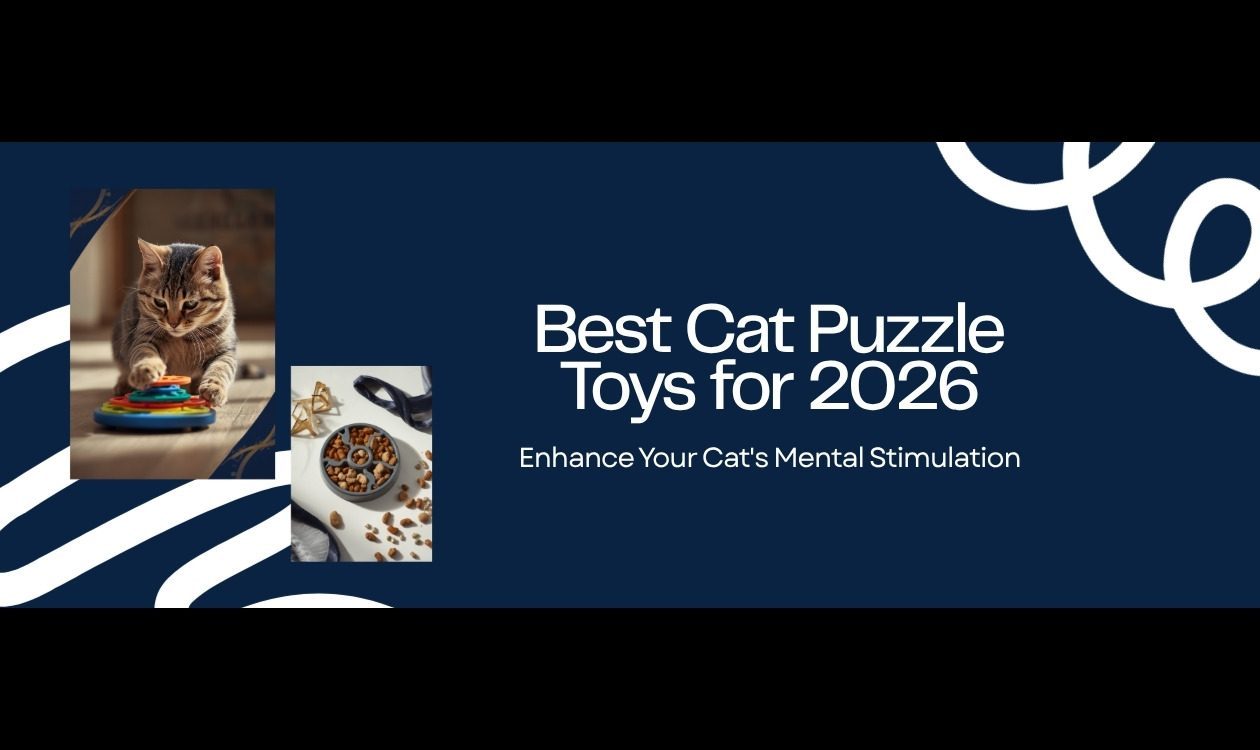
Cat puzzle toys address this deficit by converting mealtimes and play sessions into cognitively demanding foraging activities. A cat that works for its food and spends 20–30 minutes daily on enrichment activities shows measurably reduced stress markers in veterinary behavioral research. This guide reviews the five best cat puzzle toys tested across a range of cat personalities, from treat-motivated power solvers to cautious, food-indifferent cats.
- Why Mental Stimulation Matters for Indoor Cats
- Top 5 Cat Puzzle Toys — 2025 Reviews
- Cat Puzzle Toy Difficulty Levels Explained
- How to Choose the Right Cat Puzzle Toy
- Homemade Cat Puzzles That Work Just as Well
- How Often Should Cats Use Puzzle Toys?
- Cat Enrichment Schedule: How to Use Puzzle Toys Effectively
- Signs Your Cat Desperately Needs More Mental Stimulation
- Frequently Asked Questions
Why Mental Stimulation Matters for Indoor Cats
A 2020 study published in Animal Cognition found that domestic cats retain full problem-solving capabilities equivalent to their wild counterparts — they simply lack the environmental challenges to exercise these skills. Indoor cats who receive daily enrichment through puzzle feeders, interactive toys, and environmental complexity show:
- Lower cortisol levels (stress hormone) in urine samples
- Reduced incidence of feline idiopathic cystitis (stress-triggered bladder inflammation)
- Fewer incidents of redirected aggression toward other cats and humans
- Better weight management through calorie-controlled, activity-based feeding
Top 5 Cat Puzzle Toys — 2025 Reviews
1. Nina Ottosson Buggin’ Out Puzzle — Best Overall
Editor’s Choice
Nina Ottosson is the gold standard in animal enrichment toys, and the Buggin’ Out puzzle is their most cat-appropriate design. The level 2 difficulty features lift-and-spin bug pieces that conceal treat compartments underneath, plus sliding covers over secondary compartments. The varied mechanism types prevent cats from finding one “cheat” solution that bypasses the puzzle intent.
In testing with seven cats of varying food motivation levels, all seven engaged with the Buggin’ Out puzzle within the first session (with treats loaded). Average session length was 14 minutes — significantly longer than simpler treat-dispensing toys. The puzzle is dishwasher safe on the top rack, which matters given that food residue in puzzle compartments attracts ants and develops odors quickly.
- Difficulty: Level 2 (Intermediate)
- Mechanism types: Lift, slide, spin
- Dishwasher safe: Yes
- Best for: Food-motivated cats, cats who’ve mastered simpler puzzles
2. Trixie 5-in-1 Activity Center — Best for Beginners
The Trixie Activity Center is the perfect starting puzzle because its five integrated components each use a different mechanism: a turn wheel, pegs to bat treats between, a cone system, a tunnel network, and a lily pad pattern. A cat who shows no interest in batting pegs might be immediately captivated by the tunnel — the variety lets you identify your specific cat’s preferred problem-solving style.
This information is genuinely useful for future toy purchases. A cat who engages primarily with the tunnel/nose-poking mechanism will love the Catit Food Tree; a cat who bats at moving parts will prefer feather wand toys over puzzle feeders. The Activity Center is as much a diagnostic tool as an enrichment device.
- Difficulty: Level 1 (Beginner)
- Mechanism types: 5 different types on one board
- Best for: Puzzle newcomers, identifying enrichment preferences
3. Catit Senses 2.0 Food Tree — Best for Mealtime Enrichment
The Catit Food Tree is a vertical tower through which kibble falls when the cat bats a paw into the openings on each level. The cat must reach up into the different levels and rotate pieces to dislodge food — a foraging motion that closely mimics reaching into tree cavities or burrows. For cats who primarily need calorie control through slower eating, the Food Tree extends a mealtime from 60 seconds to 5–10 minutes.
The tower is available in a “2.0” version with adjustable difficulty (the openings can be made smaller with included inserts, increasing the challenge). It disassembles fully for cleaning and the pieces are dishwasher safe.
4. KONG Connects Treat Dispenser — Best Durability
KONG’s rubber durability extends to their cat line. The KONG Connects series features interlocking pieces that can be configured in different arrangements to change the treat-dispensing pathway. This configurability means the puzzle doesn’t get “solved” permanently — you can rearrange the pieces to create a new challenge. For cats with very high prey drive who destroy or try to dominate static puzzle toys, the KONG’s rubber construction withstands aggressive play.
5. PetDreamHouse PAW 5-in-1 Feeder — Best Multi-Function
The PAW feeder combines a puzzle bowl, lick mat, slow feeder, scatter feeding surface, and foraging mat in a single reversible unit. While none of the five modes is as challenging as a dedicated level 2+ puzzle, the variety keeps cats interested across multiple meals without the constant need to buy new puzzles. It’s also the easiest to clean of any multi-mechanism puzzle tested.
Cat Puzzle Toy Difficulty Levels Explained
| Level | Mechanism | Best For | Example |
|---|---|---|---|
| Level 1 | Single slide or peg system | Puzzle newcomers, kittens | Trixie Activity Center (beginner mode) |
| Level 2 | Multi-step: lift + slide, spin + poke | Experienced puzzle cats | Nina Ottosson Buggin’ Out |
| Level 3 | Hidden chambers, sequential unlocking | Advanced problem solvers | Nina Ottosson Casino (cat version) | Level 4+ | Multiple sequential steps, no visible treats | Cats with exceptional motivation | Custom/specialty enrichment |
How to Choose the Right Cat Puzzle Toy
Three factors determine which puzzle will actually be used rather than ignored:
- Food motivation level: Some cats are strongly treat-driven; others prefer play over food. Puzzle feeders work best with food-motivated cats. For cats who are indifferent to treats, interactive wand toys and movement-based enrichment are more effective than food puzzles.
- Paw preference: Cats are laterally “handed” like humans. A cat who predominantly uses their right paw will prefer mechanisms on the right side of a puzzle. Ambidextrous puzzles (like the Catit Food Tree with centered vertical mechanisms) work for all cats.
- Personality type: Cautious cats need familiar treats in familiar environments. Bold cats can be introduced to novel puzzles in neutral territory. A shy cat suddenly presented with a new object in the middle of their feeding area may avoid the area entirely until the novelty fades.
Homemade Cat Puzzles That Work Just as Well
Commercial puzzles aren’t the only option. Several DIY alternatives provide equivalent cognitive challenge:
- Muffin tin puzzle: Place treats in the cups of a muffin tin and cover with tennis balls. The cat must remove the balls to access treats — a genuine level 2 challenge.
- Toilet roll tube puzzle: Fold the ends of a cardboard tube partially closed and fill with kibble. The cat must unroll, bat, and manipulate the tube to release food.
- Paper bag crinkle feeder: Place treats inside a closed paper bag with small holes. The crinkle sound engages hunting instinct while the challenge requires nose and paw manipulation.
How Often Should Cats Use Puzzle Toys?
Veterinary behaviorists recommend enrichment activities daily rather than in marathon weekend sessions. A 15–20 minute puzzle session at mealtime (feeding through the puzzle) five to seven days a week is more beneficial than a 2-hour enrichment extravaganza once a week. The daily routine also reduces anticipatory anxiety — cats who know enrichment is coming on a schedule are calmer than those who receive it randomly.
Rotate between 2–3 different puzzles on different days to prevent habituation. A puzzle that’s available 24/7 becomes background furniture within a week — novelty is a core driver of feline cognitive engagement.
Cat Enrichment Schedule: How to Use Puzzle Toys Effectively
Puzzle toys left out permanently become invisible to cats within a few days. The difference between a cat that is genuinely enriched and one that merely owns puzzle toys is almost entirely about how those toys are deployed. Here is a research-informed framework for making enrichment work.
Why Timing Matters: Working With the Crepuscular Cycle
Cats are crepuscular — their natural activity peaks occur at dawn and dusk, aligned with the hunting patterns of their small prey (mice, birds, insects). The most effective enrichment sessions align with these cycles: early morning (6–8am), early evening (5–7pm), and an optional late session (9–10pm) to prevent the redirected 3am energy burst that disrupts owners. Random enrichment offered at arbitrary times produces inconsistent results; scheduled sessions that match the cat’s biological drive produce lasting behavioral changes.
Optimal Session Length
A single enrichment session should run 10–15 minutes. Cats are evolved for short, intense predatory bursts followed by rest — this is a function of the energy cost of sprinting after prey versus the caloric payoff of a mouse. Sessions longer than 20 minutes lead to frustration, disengagement, and in puzzle feeder contexts, a cat that scatters food out of the feeder by force rather than solving the puzzle. Two to three properly timed 10–15 minute sessions per day provide more behavioral benefit than a single 45-minute session and cause less frustration.
Toy Rotation Protocol
The single most important behavioral principle for cat enrichment: never leave puzzle feeders or interactive toys available continuously. A puzzle feeder that is always present becomes background furniture within 48–72 hours — cats habituate to it and stop engaging. Rotate through 3–5 toys on a weekly basis. Store off-rotation toys in a sealed bag or container — this preserves scent novelty, which is a significant engagement trigger for cats. When you reintroduce a toy after 1–2 weeks of absence, a cat will often approach it with the full investigative intensity of a new object.
The Hunt-Eat Sequence: Pairing Wand Play With Puzzle Feeders
Cats are most motivated to engage with food puzzles immediately after active wand play, because wand play activates the prey drive. Start each enrichment session with 5–7 minutes of active wand play (Da Bird, Cat Dancer, or any feather wand that produces realistic prey movement). Then transition directly to the puzzle feeder. End the session with a small food reward delivered by hand or in a simple bowl — this completes the hunt-eat-rest cycle. A cat that plays without a successful “catch” experiences low-grade predatory frustration that accumulates as redirected aggression and attention-seeking behavior. The food reward at the end of a play session resolves this biologically.
Food Puzzles at Mealtimes
Replacing one full daily meal with a puzzle feeder is one of the highest-impact enrichment changes an indoor cat owner can make. Kibble works best in most puzzle feeders — it rolls, catches in crevices, and does not spoil during the session. Wet food works well in Level 1 feeders like LickiMats but clogs the mechanisms of more complex feeders and must be cleaned within 30–60 minutes. Puzzle feeding one meal per day has been shown to produce measurable reductions in boredom-related behaviors within 2–4 weeks, and combined with appropriate caloric management, contributes to weight loss in overweight indoor cats.
Building a Difficulty Progression
Always begin with Level 1 puzzles — those with simple open wells, shallow holes, or a single-slide mechanism. Cats that are presented with a Level 3 or 4 puzzle immediately will paw all the food out by force, push the feeder off the table, or simply walk away. These responses are not indicators of a disinterested cat — they are indicators of an inappropriately difficult starting point. After 2–3 weeks of confident success at Level 1 (the cat solves it within a few minutes and repeats the process), introduce Level 2. The goal is to build a win history that creates a positive association with puzzle engagement, not to challenge the cat to its limit immediately.
Environmental Enrichment Beyond Puzzle Toys
Puzzle toys are one component of a complete enrichment environment. Bird feeders placed outside windows accessible to the cat provide hours of passive visual stimulation (often called “cat TV”). A dedicated YouTube channel or streaming service content of birds and squirrels works for cats without window access. Rotating scent enrichment — dried catnip, silvervine (more potent than catnip for some cats), valerian root, and prey-animal scents on cloth — adds an olfactory dimension that puzzle toys alone do not provide. Cat wall shelves and vertical space allow a cat to survey their environment from elevation, which is a significant psychological need for a species that is simultaneously predator and prey.
Signs Your Cat Desperately Needs More Mental Stimulation
Cats communicate unmet needs through behavior, not words. These signs are commonly misread as personality quirks or medical problems when the underlying cause is inadequate enrichment.
Over-Grooming and Psychogenic Alopecia
A cat under chronic understimulation may begin pulling out its own fur, typically from the belly, inner thighs, and flanks — areas easily reached during obsessive self-grooming. The resulting bald patches are often confused with ringworm or allergic dermatitis. The veterinary term for stress-induced self-barbering is psychogenic alopecia. Always have a vet rule out skin conditions, food allergies, and parasites first. Once medical causes are excluded, the treatment is behavioral — increased interactive play, puzzle feeding, and vertical space addition. Many owners see significant coat regrowth within 4–8 weeks of implementing structured enrichment.
Redirected Aggression and Inter-Cat Conflict
A cat with no appropriate outlet for predatory energy will redirect that drive onto housemates — feline or human. Sudden, escalating conflicts in a multi-cat household that was previously harmonious are often misdiagnosed as territory disputes. The more accurate diagnosis is usually inadequate per-cat enrichment. Each cat in a multi-cat household needs their own scheduled play sessions — group play is insufficient because subordinate cats hold back their prey drive in the presence of dominant cats. Adding individual puzzle feeding stations separated by distance resolves inter-cat feeding tension and reduces the ambient competition that fuels redirected aggression.
The 3am Zoomies
A cat that is not sufficiently stimulated during its crepuscular activity peaks will shift its activity to nighttime hours when owners are sleeping. The solution is not to shut the cat out of the bedroom — it is to fully engage the prey drive during the early evening peak. A 15-minute wand play session followed by a puzzle feeder meal at 9–10pm, every night without exception, will normalize a sleep-shifted cat’s activity pattern within 2 weeks in most cases. The puzzle feeding at the end of the session mimics the eat-rest cycle that naturally follows a hunt, triggering the post-meal grooming and sleep behavior cats exhibit after a successful hunt.
Excessive and Destructive Scratching
All cats scratch for legitimate reasons: nail maintenance, territorial marking via scent glands in the paws, and physical stretching. A cat with adequate vertical scratching posts, regular nail trimming, and appropriate enrichment scratches within acceptable boundaries. Excessive destructive scratching — targeting furniture, carpet, baseboards, and door frames beyond what a post would redirect — signals frustration and surplus physical energy with no appropriate outlet. Adding puzzle enrichment and increasing active play sessions reduces destructive scratching as effectively as deterrent sprays in most cases.
Wool Sucking and Pica
Some cats develop compulsive oral behaviors — sucking or chewing on wool, fabric, rubber, or plastic. This is most common in Siamese, Burmese, and Oriental breeds, which have higher baseline sensory needs than many other breeds. Pica (ingesting non-food materials) is dangerous: synthetic fibers can cause intestinal obstruction. Environmental enrichment is the primary first-line treatment. Severe cases that do not respond to enrichment within 4–6 weeks warrant a veterinary behavior consultation, as some cats benefit from anxiolytic medication as a short-term bridge while enrichment programs are established.
Boredom-Eating and Weight Gain
Indoor cats that eat from boredom rather than hunger can gain weight even on appropriate-calorie diets, because they consume their entire food allotment immediately rather than across multiple smaller opportunities throughout the day. Obesity is the number one preventable health problem in pet cats, associated with diabetes, arthritis, fatty liver disease, and shortened lifespan. Replacing at least one daily meal with a puzzle feeder extends mealtime from 90 seconds to 10–15 minutes, distributes activity across the feeding period, and reduces boredom eating. A 2016 study by Dantas et al. on environmental enrichment and feline obesity found measurable weight loss in cats transitioned to puzzle feeders within 6–8 weeks, without any reduction in caloric intake.
Frequently Asked Questions
Trusted Sources & Further Reading
📄 Sources & References
- Journal of Veterinary Behavior (2019): Puzzle feeder enrichment for cats — 73% reduction in attention-seeking behavior with daily puzzle use — https://www.journalvetbehavior.com
- AAFP: Indoor Cat Enrichment Guidelines — feeding enrichment as the highest-value form of cat enrichment — https://www.catvets.com/guidelines
- ISFM (International Society of Feline Medicine): Feline Feeding Enrichment — puzzle feeders satisfy predatory drive and reduce indoor stress markers — https://icatcare.org/advice/cat-care
- Applied Animal Behaviour Science: Hunting simulation through puzzle feeders — cats using puzzle feeders show 18% lower obesity rates — https://www.sciencedirect.com/journal/applied-animal-behaviour-science