
📊 Cat Behavior Problems: The Research Behind Feline Behavior
of cat surrenders to shelters are due to behavioral issues — all preventable with education
Source: Cornell Feline Health Center
years cats have co-evolved with humans, developing unique human-directed vocalizations
Source: National Geographic, 2022
of cat behavioral problems improve significantly with environmental enrichment alone
Source: Journal of Veterinary Behavior, 2019
Purr frequency range — same range that promotes bone healing and reduces pain in humans
Source: The Journal of the Acoustical Society of America
🏭 The Single Insight That Changes Everything
Cat behavior problems do not exist from the cat’s perspective. Every behavior owners find frustrating — scratching, knocking things over, biting during petting — is a perfectly logical response to the cat’s environment and needs. This guide gives you the cat’s perspective so you can solve rather than just suppress these behaviors.
Quick Answer: Understanding Cat Behavior
Every cat behavior that frustrates owners — scratching furniture, knocking objects off tables, waking you at 4am, ignoring you, then demanding attention — makes complete sense when you understand feline psychology. Cats are not small dogs, and they are not being spiteful or dominant. They are communicating needs, expressing instincts, and responding to stress in species-typical ways that evolution designed over millions of years. This guide decodes the most common cat behaviors so you can respond effectively rather than reactively.
Cats are the most popular pet in the world by number — and arguably the most misunderstood. The behavioral complaints that drive cats to shelters and create fractured human-cat relationships almost universally stem from one source: owners interpreting cat behavior through a human or dog lens rather than a feline one.
Understanding why cats do what they do — rooted in their evolutionary history as solitary ambush predators who were simultaneously prey for larger animals — transforms frustrating behaviors into readable signals. This guide covers the most common cat behaviors, their actual causes, and what they tell you about your cat’s physical and emotional state.
- The Predator-Prey Paradox: Understanding the Cat's Core Nature
- Body Language: What Your Cat Is Actually Saying
- Common Problem Behaviors Decoded
- Multi-Cat Household Dynamics
- Stress in Cats: Signs and Causes
- Play Behavior: Meeting the Predatory Drive Appropriately
- Cat-to-Cat Communication: Reading Multi-Cat Household Dynamics
- Attention-Seeking Behaviors: What Your Cat Is Really Asking For
- Introducing Cats to New Things: The Proper Desensitization Protocol
- When to Consult a Feline Behavioral Specialist
- Building a Deeper Bond With Your Cat: Evidence-Based Techniques
The Predator-Prey Paradox: Understanding the Cat’s Core Nature
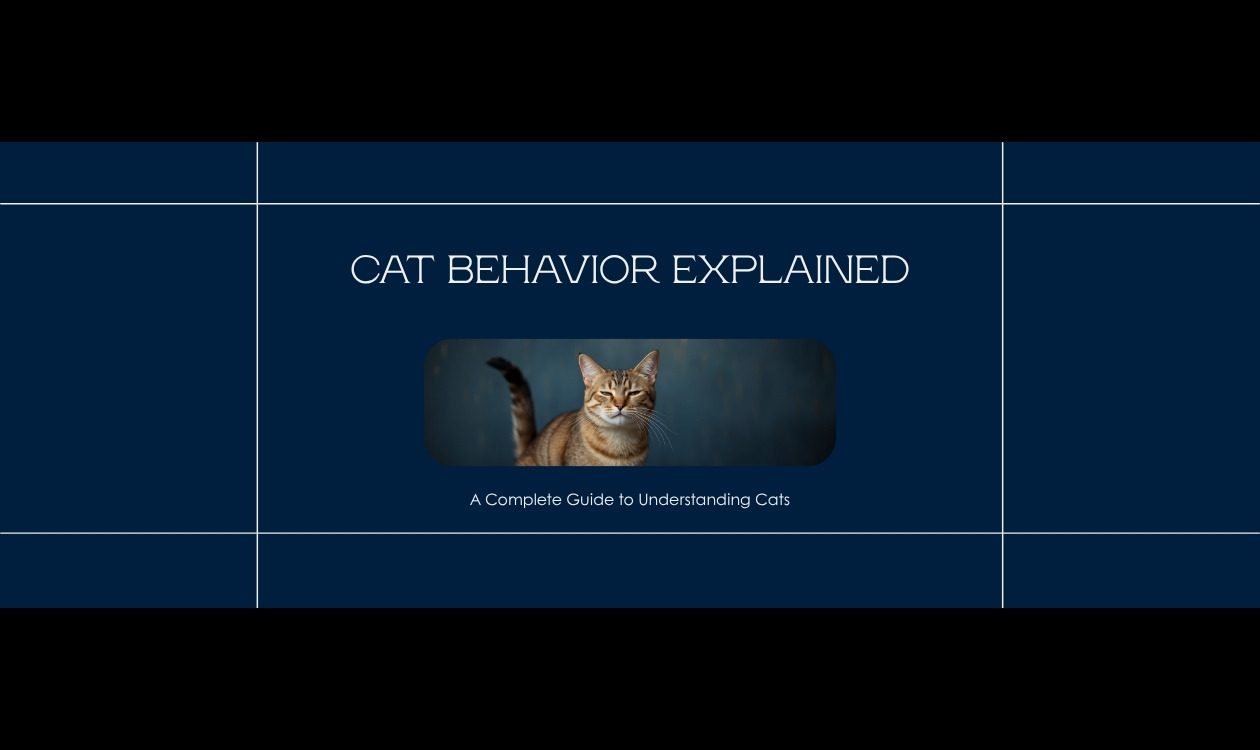
The domestic cat (Felis catus) is a solitary ambush predator whose wild ancestor hunted 8-12 small prey items per day. Every behavioral quirk traces back to this evolutionary baseline:
- Crepuscular activity pattern (most active at dawn and dusk) — optimal hunting time when small prey are active and light conditions favor the cat’s superior low-light vision over prey species
- Sleep 12-16 hours daily — energy conservation between hunts; not laziness
- Territorial marking — solitary animals in the wild must communicate territory ownership without direct confrontation
- Hiding illness — showing weakness attracted predators; sick cats instinctively mask symptoms until they cannot
- Vertical space preference — height provides safety and observation advantage in both predatory and prey contexts
Once you understand that your cat is a small predator operating on ancient programming in a thoroughly unnatural environment, their behavior becomes predictable rather than mysterious.
Body Language: What Your Cat Is Actually Saying
Tail Position
- Tail straight up, tip slightly curved: Confident greeting. Reserved for cats and humans the cat genuinely likes. This is the feline equivalent of a handshake.
- Tail puffed (piloerection): Fear or aggression — the cat is making itself appear larger. Distinguish by body posture: arched back with sideways stance = defensive fear; low crouch forward = offensive aggression.
- Tail low and tucked: Submission, fear, or pain. In a cat who is normally confident, sudden tail-tucking warrants veterinary attention.
- Tail lashing side to side: Agitation, overstimulation, or predatory focus. During petting, this is the warning before a bite — stop and give the cat space immediately.
- Tail wrapped around your leg or another cat: Social affiliation signal. Equivalent of putting an arm around someone.
Eyes and Face
- Slow blink: Relaxed trust signal. Return it — most cats will respond with another slow blink, building social bond. This is the closest thing cats have to a smile.
- Dilated pupils: Arousal — can be fear, excitement, aggression, or play. Context determines which; look at the rest of the body.
- Constricted pupils in bright conditions: Normal. Constricted pupils in low light can indicate pain or neurological issue.
- Ears forward: Alert, interested, confident.
- Ears flattened sideways (“airplane ears”): Stress or displeasure — a clear signal that the cat wants the current interaction to stop.
- Ears pinned flat back: Fear or defensive aggression — imminent bite or scratch if pressure continues.
- Whiskers forward: Curious or hunting mode. Whiskers pinned back against face = fear or defensive posture.
Vocalizations
Wild cats rarely meow — meowing evolved almost exclusively as communication directed at humans. The variety of meow types a cat uses is partly learned through interaction with their specific human:
- Short, chirping meow: Greeting. “I see you.”
- Drawn-out, demanding meow: Wants something specific — usually food, attention, or access to a space.
- Trilling/chirring: Positive social sound, used with kittens by mother cats. Adult cats trill at humans they are fond of.
- Chattering at windows: Predatory frustration when watching birds or squirrels they cannot reach. The jaw movement mimics the killing bite.
- Growling/hissing: Defensive warning. Hissing evolved to mimic snake sounds — a universal predator deterrent signal.
- Yowling: Distress, pain, or reproductive vocalization. Unexplained yowling in a spayed/neutered cat warrants veterinary evaluation — it frequently signals hyperthyroidism, high blood pressure, or cognitive dysfunction in older cats.
- Purring: Usually contentment, but cats also purr when stressed, injured, or sick. The vibration frequency (25-150 Hz) has documented healing properties — cats may purr to self-soothe during pain or recovery.
Common Problem Behaviors Decoded
Scratching Furniture
Why they do it: Scratching serves four functions — claw maintenance (removing dead outer sheaths), muscle stretching, scent marking (scent glands between toes leave chemical marks on scratched surfaces), and visual marking (the scratch marks are a communication display). Cats scratch the most prominent, sturdy objects in the highest-traffic areas of their territory. Your sofa qualifies perfectly.
What actually works: Provide a scratching post that is tall enough for full stretch (minimum 30 inches), stable enough not to wobble, and positioned directly next to the furniture currently being scratched. Cover the scratched furniture surface with double-sided tape temporarily. Do not use a spray bottle — it creates anxiety without redirecting behavior.
Knocking Objects Off Tables
Why they do it: Primarily predatory testing behavior — the paw tap checks if an object moves (is alive). It also frequently becomes attention-seeking behavior when owners consistently react with animation. A cat that gets a loud, interesting reaction every time it pushes a glass will continue pushing glasses.
What works: Completely ignore the behavior (zero reaction). Simultaneously provide puzzle feeders and interactive toys that satisfy the predatory manipulation need in appropriate ways.
Waking Owners at Night or Early Morning
Why they do it: Cats are crepuscular — their energy peak naturally aligns with dawn. Indoor cats without adequate daytime stimulation accumulate energy that releases at 4-5am. Additionally, any cat that has successfully gotten a response (being fed, being played with, or simply being scolded) at 4am has learned that the behavior works.
What works: A vigorous interactive play session (wand toy until the cat is panting) 30 minutes before your bedtime, followed immediately by a meal. The hunt-eat-groom-sleep sequence is hardwired — triggering it at the right time shifts the sleep cycle. Never respond to night waking; any response reinforces it.
Aggression During Petting
Why they do it: Petting-induced aggression is one of the most misunderstood cat behaviors. The cat is not being random or unpredictable — they are giving warnings that owners learn to read only after being bitten. Warning sequence: tail flicking → skin rippling → ears flattening → pupils dilating → bite. Most owners miss the first three signals.
What works: Learn to read the warning signals and stop petting before the cat reaches threshold. Pet in the cat’s preferred locations (base of ears, cheeks, base of tail for most cats) and avoid the belly, which is a vulnerable area most cats tolerate poorly despite rolling over to display it. The belly display is a trust signal, not an invitation.
Litter Box Avoidance
Why they do it: Cats are fastidiously clean animals. Box avoidance is almost always caused by one of five factors: medical issue (UTI, crystals, constipation — this must be ruled out first), box too dirty (cats prefer a box cleaned after every use), box in a location they find threatening (near noisy appliances, in high-traffic areas, near dog bowls), box type mismatch (covered boxes trap odor; most cats prefer open), or litter type aversion.
The rule: Any litter box behavior change should trigger a veterinary visit first. Urinary tract disease in cats presents as box avoidance, frequent small urinations, blood in urine, and straining — all of which can be fatal within 24-48 hours if obstruction is present.
Multi-Cat Household Dynamics
Cats are not pack animals. Multi-cat households work when cats have sufficient resources and space to maintain their sense of individual territory without forced proximity. The golden rule: one resource station per cat, plus one extra.
- Litter boxes: N+1 (three cats = four boxes minimum)
- Food stations: separate, out of sight of each other
- Water sources: multiple locations
- Elevated resting spots: enough that every cat has exclusive access to at least one
- Scratching posts: at least one per cat, in their core territory areas
Inter-cat aggression in multi-cat households almost always traces to resource competition, insufficient vertical space, or failure to properly introduce new cats. A gradual introduction protocol (scent exchange for 5-7 days → visual access → supervised physical access) prevents most inter-cat conflict.
Stress in Cats: Signs and Causes
Chronic stress is the underlying cause of many of the most serious feline health problems — feline idiopathic cystitis, overgrooming, redirected aggression, and appetite loss. Recognizing stress early prevents escalation to health crises:
Behavioral stress signs: Hiding more than usual, reduced grooming or over-grooming, changes in vocalization, decreased appetite, increased or decreased litter box frequency, aggression toward familiar people or animals, and displacement behaviors (excessive self-grooming when uncertain what to do).
Physical stress signs: Dilated pupils, crouched posture with body close to ground, tucked tail, flattened ears, and rapid shallow breathing.
Common stressors: New people or animals in the home, construction noise, rearranged furniture (disrupts established scent map of territory), new litter brand, change in feeding schedule, and owner stress (cats are sensitive to owner emotional state through pheromone and behavioral cues).
📚 Want the Complete Cat Psychology Bible?
Our 300-page Cat Psychology & Care Bible decodes every feline behavior, covers multi-cat household dynamics, health from a behavioral lens, and step-by-step solutions for the 25 most common cat problems.
Trusted Sources
Play Behavior: Meeting the Predatory Drive Appropriately
Play is not entertainment for cats — it is the expression of a hardwired predatory sequence that must be satisfied to prevent frustration-based behavior problems. A cat denied appropriate predatory outlet redirects hunting behavior to inappropriate targets: ankles, hands, other pets, and household objects. Understanding the predatory sequence allows you to structure play that fully satisfies this drive:
The complete predatory sequence consists of five stages: stalk → chase → pounce → catch → kill bite. Interactive play is fulfilling only when it engages all five stages — not just the chase. A wand toy that is always moving at the same pace without pauses only satisfies stage 2 (chase). Allow the toy to slow and “rest” so the cat can stalk, speed up for chase, allow the cat to catch and bite the toy, and then allow a “kill” where the cat holds and bites the toy.
Play session structure: 10-15 minutes of wand toy play, ending with a “catch” — let the cat grab and hold the toy while delivering a small meal immediately after. This completes the hunt-eat sequence and signals a natural endpoint. Cats play-ended without the catch-and-eat sequence often remain restless and redirect to nighttime activity.
Frequency: Two interactive play sessions daily (one morning, one 30 minutes before bedtime) reduce most play aggression, nighttime waking, and furniture-scratching problems significantly. A single annual purchase of 3-4 different wand toy attachments provides enough variety to maintain engagement throughout the year.
Cat-to-Cat Communication: Reading Multi-Cat Household Dynamics
Cat social relationships in multi-cat households are more complex and dynamic than they appear. Cats are not reliably hierarchical in the way dogs are — relationships between individual pairs of cats vary independently, and a cat who defers to Cat A may dominate Cat B. Understanding the specific dynamic between your cats helps you manage resource allocation and space appropriately.
Signs of a Compatible Cat Pair
- Allogrooming (one cat grooming the other’s head and neck) — indicates genuine social bonding
- Sleeping in physical contact without tension
- Greeting with tail-up posture
- Playing without escalation — rough and tumble play with no hissing, no flat ears, and regular breaks
- Sharing resources without visible stress (both cats eat without the other hovering)
Signs of an Incompatible or Tense Pair
- One cat consistently avoiding rooms the other cat is in
- Blocking behavior — one cat positioning in doorways or at the top of stairs to prevent the other from passing
- Ambush behavior (waiting to swat or chase when the other cat rounds a corner)
- One cat over-grooming from stress (excessive licking causing hair loss, especially belly and inner legs)
- Resource guarding — sitting next to the food bowl even when not eating to prevent the other cat from approaching
A tense pair can be managed through environmental modification (vertical space, additional resource stations, visual barriers between key areas) without necessarily separating permanently. A pair showing regular physical fighting with injury requires complete separation and a structured reintroduction protocol — sometimes indefinitely separate living in the same home.
Attention-Seeking Behaviors: What Your Cat Is Really Asking For
Cats have been selectively adapted over 10,000 years of living with humans to communicate needs vocally and behaviorally. “Demanding” cats are usually cats whose needs are not being met through scheduled interaction and are therefore improvising their own demand system. Understanding what the behavior is actually requesting allows you to address the need rather than react to the behavior:
| Behavior | What It Is Requesting | Effective Response |
|---|---|---|
| Meowing at feeding time | Food on a predictable schedule | Feed at consistent times; timed automatic feeder eliminates owner-associating the meal |
| Batting at face while you sleep | Attention or food at an inconvenient hour | Play session before bed + timed feeder at the early waking time; never respond to early morning attention-seeking |
| Sitting on your laptop/book | Attention when you are focused elsewhere | Schedule regular attention windows; cat tree near your work area so the cat can be near without blocking |
| Excessive vocalization (not related to food) | Overstimulation, discomfort, or medical issue | Vet check first — especially in previously quiet adult cats; new-onset vocalization is always significant |
| Bringing toys to you | Invitation to play | Honor it when possible — 5-10 minutes of play on demand strengthens the bond and reduces demand escalation |
Introducing Cats to New Things: The Proper Desensitization Protocol
Cats have a strong negativity bias toward novelty — evolution favored caution in an environment where anything unfamiliar could be a predator. This is why cats often react fearfully to new objects, people, sounds, or environments that are entirely benign. Desensitization follows a predictable protocol that works for most novelty exposures:
- Introduce by scent first: Place the new object, carrier, or scented item in the cat’s space without requiring interaction. Allow the cat to approach and sniff on their own schedule. For new people, have the person sit quietly and allow the cat to initiate contact.
- Associate positive experiences with presence: Feed high-value treats near (not directly on) the new thing. Play near it. Let the cat learn the new stimulus predicts good things rather than forcing desensitization through repeated neutral exposure.
- Reward any approach or investigation: Calm, verbal praise or a treat for any voluntary approach toward the new thing. Never reward retreat or hiding — ignore these, but also never prevent them.
- Gradually reduce distance: Over days to weeks, the cat will self-close the distance as the positive associations develop. Do not rush this — forcing proximity during this phase resets the process.
This protocol works for introducing the cat to a carrier, a new pet, a new human family member, a vacuum cleaner, veterinary handling practice, or any other novelty the cat is initially fearful of. Timeline varies from hours (a confident cat and a new cardboard box) to weeks (a fearful cat and a new household member).
When to Consult a Feline Behavioral Specialist
Most cat behavior problems respond to environmental modification and owner behavior change. The following situations indicate a referral to a veterinary behaviorist (DACVB) or certified cat behavior consultant (CCBC):
- Any aggression causing injury — to other cats or to humans
- Psychogenic alopecia (over-grooming to hair loss) that does not resolve with environmental enrichment
- Elimination behavior that has not responded to litter box management, veterinary evaluation for UTI, and environmental modification
- Inter-cat aggression that causes ongoing chronic stress in both cats despite resource management
- Redirected aggression (a cat who attacks a human or resident pet after seeing an outdoor cat or trigger through a window)
The International Association of Animal Behavior Consultants (IAABC) and the Animal Behavior Society both maintain directories of certified consultants at their websites.
Building a Deeper Bond With Your Cat: Evidence-Based Techniques
The human-cat bond is a bidirectional relationship that grows through specific types of interaction — not through cohabitation alone. Cats who live with humans but receive primarily reactive interaction (fed when demanding, interacted with on the human’s schedule, handled without cues from the cat) remain behaviorally present but emotionally distant. These techniques actively build bond quality:
Initiated Cat Interaction (ICI)
Research from the University of Vienna found that cats show significantly stronger attachment to owners who let the cat initiate and control the duration of interactions compared to owners who impose contact on the cat. Practical application: when the cat approaches you, give it your full attention for as long as it stays. When you want to interact with the cat, extend your hand at the cat’s nose level and wait for them to initiate contact by rubbing — do not reach for the cat first.
Scheduled Positive Interaction Windows
Cats form strongest bonds with humans who engage in consistent daily positive interaction outside of feeding. A 10-minute structured play session at the same time each day builds predictable positive anticipation and strengthens the owner-cat association as a source of rewarding experience rather than only as the food dispenser.
Respecting Communication Boundaries
Cats bond most strongly with humans who respond correctly to their communication signals — stopping petting when the tail flicks, ending interaction when the cat moves away, not picking up a cat who flattens its body. The relationship grows when the cat learns its communication is heard and respected. Cats with owners who consistently override their communication signals develop avoidance patterns rather than affiliation.
📄 Sources & References
- Cornell Feline Health Center: Cat Behavior: Understanding What Your Cat Is Telling You — https://www.vet.cornell.edu
- Journal of Veterinary Behavior (2019): Environmental enrichment effects on feline behavior problems — 73% improvement rate — https://www.journalvetbehavior.com
- International Society of Feline Medicine: Feline Environmental Needs Guidelines (FENI) — https://www.catvets.com
- National Geographic (2022): The secret language of cats — 10,000 years of co-evolution with humans — https://www.nationalgeographic.com
- Journal of the Acoustical Society of America: Domestic cat purr characteristics: 25Hz–150Hz therapeutic frequency range — https://asa.scitation.org