Google AI Overviews now trigger on roughly 48% of tracked search queries, and brands that get cited inside them earn about 120% more organic clicks per impression than brands that don't appear at all. If you're wondering how to appear in Google AI Overviews, the short answer is: get indexed, get specific, get corroborated, and structure your content so an AI system can lift a clean, quotable answer straight from your page. This guide breaks down exactly how to rank in AI Overviews, why the old "just rank #1" playbook no longer guarantees a citation, and the practical steps that actually move the needle in 2026.
What Are Google AI Overviews, Exactly?
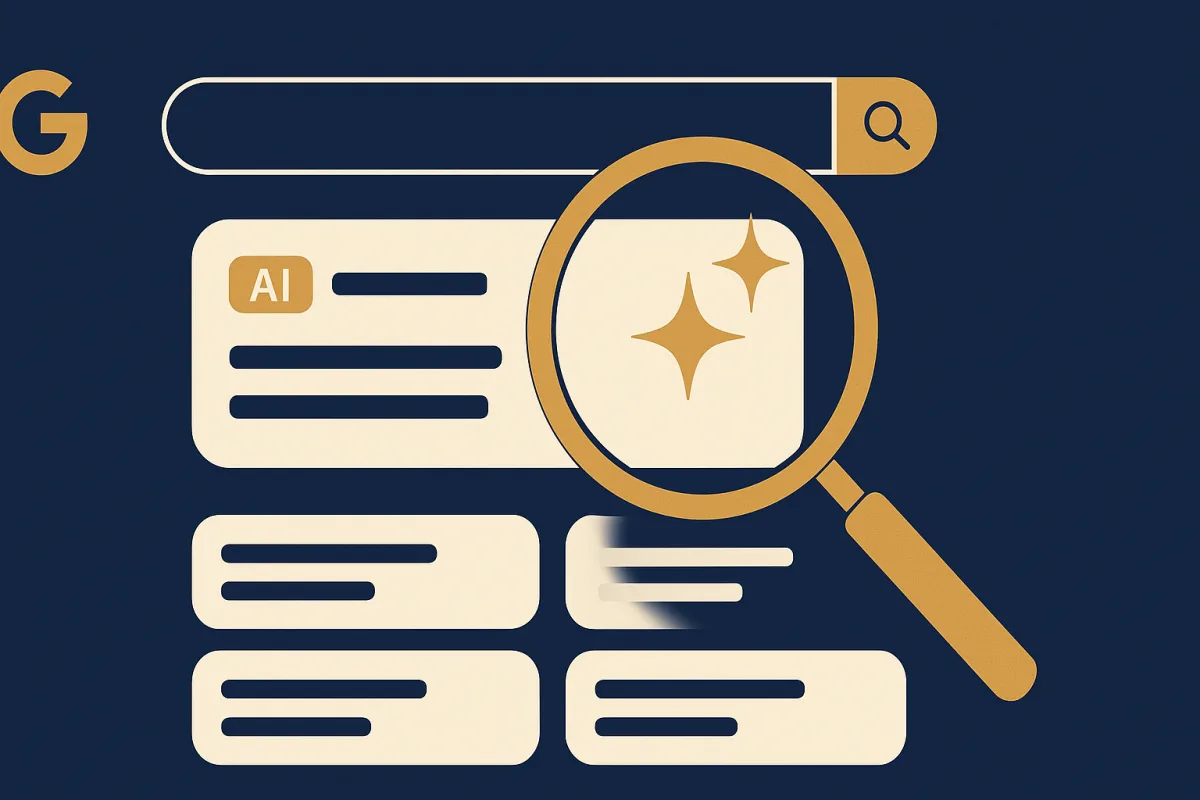
Google AI Overviews are AI-generated summaries that appear above traditional blue-link results, synthesizing information from multiple web sources into a single answer with citation links. Unlike the old featured snippets, which pulled one exact passage from one page, an AI Overview blends and paraphrases content from several sources at once — meaning your page can be a partial source even if you don't hold the #1 ranking spot.
AI Overviews are powered by Gemini and Google's Search Generative Experience infrastructure, and they now reach an estimated 2 billion monthly users across more than 200 countries and 40+ languages. They differ from a classic featured snippet in three important ways:
- Multi-source synthesis: an Overview typically draws from 4-10 different pages, not just one.
- Conversational phrasing: the answer is rewritten in Google's own voice rather than quoted verbatim.
- Follow-up expansion: users can tap to ask related questions, pulling in additional cited sources in real time.
This is also the entry point into what the industry now calls Generative Engine Optimization (GEO) — optimizing content not just to rank, but to be selected, quoted, and cited by AI systems like AI Overviews, ChatGPT, and Perplexity.
How Do Google AI Overviews Actually Work?
Google AI Overviews work by running your query through a retrieval step that identifies dozens of relevant, indexed pages, then a generation step where Gemini synthesizes those sources into a coherent summary and attaches citation links to the specific claims it borrowed. The whole process happens in milliseconds and re-runs per query, so the same page can appear one day and disappear the next.
Under the hood, the system runs what researchers now call "query fan-out": your original search is broken into several related sub-queries, each of which retrieves its own set of candidate pages before the results are merged into one answer. That's why a single well-optimized page rarely wins on its own — Google is often stitching together answers to three or four implicit sub-questions inside one visible query. A May 2026 meta-analysis by Zyppy of 54 separate studies ranked "fan-out rank" (how well a page performs across those related sub-queries) as one of the top five ranking factors for citation, alongside URL accessibility, base search rank, preview/snippet control, and query-answer match strength.
Practically, this means the pages Google cites are the ones that answer the visible question and the two or three questions hiding underneath it — which is exactly why comprehensive, well-organized content out-competes a single narrow blog post.
Which Searches Trigger an AI Overview?
AI Overviews trigger most often on informational "why," "how," and "what is" queries, definition searches, comparison questions, and longer long-tail phrases of seven or more words — not on short navigational or transactional searches where the user clearly wants a specific site or to buy something immediately. If your target keyword is a question a person would ask a knowledgeable friend, it's a strong AI Overview candidate.
Query types most likely to surface an Overview include:
- Definitional queries ("what is technical SEO")
- Process/how-to queries ("how to appear in Google AI Overviews")
- Comparison queries ("SEO vs PPC for small business")
- Multi-part or complex research queries that benefit from synthesis
- Local and "best of" queries with informational intent layered on top
Queries that rarely trigger an Overview: branded searches, single-word navigational queries, and highly transactional "buy now" searches where Google favors shopping ads and product listings instead. If you're building a content calendar around this, prioritize the question-shaped keywords your customers are already typing into Google and into ChatGPT.
How Does Google Choose Which Sources to Cite?
Google selects AI Overview sources using a blend of topical relevance, page-level authority, and corroboration — meaning it favors pages that say the same core fact as multiple other trustworthy sources, not just the page that ranks #1. A page can win a citation by being unusually clear, specific, well-structured, or by covering a sub-question competitors ignore, even from page two of the results.
Three signals matter most in source selection:
- Relevance — how precisely the page's content matches the query and its underlying sub-questions (query-answer match).
- Authority — domain and page-level trust signals, backlink profile, and topical depth, closely tied to E-E-A-T in SEO.
- Corroboration — whether the claim on your page is echoed by other credible sources Google already trusts, reducing hallucination risk in the generated answer.
This corroboration requirement is the biggest mindset shift for marketers: writing something true and unique isn't enough if no other authoritative source backs it up. The safest strategy is to combine an original insight or original data point with clearly stated, well-established facts the AI can cross-verify elsewhere.
Does Ranking in the Top 10 Still Matter?
Yes, ranking well still matters, but it is no longer a prerequisite. Independent studies found that only about 38% of AI Overview citations came from pages ranking in the traditional top 10 in early 2026, down sharply from 76% roughly a year earlier — meaning a majority of citations now come from pages outside the classic first page.
Here's what the shift looks like in the data researchers have published:
| Metric | ~2024-2025 | Early-Mid 2026 |
|---|---|---|
| Share of AI Overview citations from top-10 organic results | ~76% | ~38% |
| Traditional ranking-to-citation correlation (r-value) | 0.43 (pre-2024) → 0.23 | ~0.18 |
| Query fan-out (sub-question) influence on citation | Minor factor | Top-5 ranking factor |
| Pages cited despite ranking on page two or lower | Rare | Increasingly common |
The practical takeaway: keep investing in fundamentals — technical SEO, page speed, crawlability, and backlinks — because a healthy ranking still improves your odds. But don't assume the #1 spot guarantees a citation, and don't assume a page ranking #7 or #12 is locked out either. Structure, specificity, and corroboration can close the gap that raw ranking position used to control.
Step 1: Structure Your Content to Answer First
The single highest-leverage change you can make is putting a direct, complete answer to the section's question in the first 40-60 words under every heading, before any story, stat, or setup. AI Overviews and AI chat engines are built to extract clean, self-contained answer blocks, and a page that buries its answer in paragraph three simply gives the model nothing clean to lift.
To apply this in practice:
- Write every H2 as the actual question a user would type or ask out loud.
- Answer it directly in the first sentence or two beneath the heading — no throat-clearing.
- Follow the direct answer with supporting detail, examples, and nuance for human readers who scroll further.
- Use short paragraphs (2-4 sentences) and scannable lists so the "answer unit" is visually distinct.
This is the same discipline behind winning the old featured snippet box, and you can sanity-check how your page previews in search using a free SERP snippet preview tool before you publish.
Step 2: Build Real Information Gain, Not Rehashed Content
Information gain means your page adds something a searcher can't already get from the other nine results Google is looking at — a proprietary data point, a named case study, a specific process, or an expert opinion stated in your own words. Google's generative systems are explicitly trained to favor content that reduces redundancy in the answer set, not content that echoes what's already ranking.
Ways to create genuine information gain:
- Publish original data from your own campaigns, tools, or customer base (even small sample sizes beat generic restatements).
- Name specific numbers, timeframes, and tools instead of vague claims like "many businesses see improvement."
- Add a genuinely useful table, checklist, or calculator the top-ranking competitors don't have.
- Take a clear point of view — hedge-everything content gets summarized as filler, not cited as an authority.
If ten articles all say "structured data helps SEO," none of them stand out. The one that says "we tested FAQ schema across 40 client pages and saw AI Overview citation frequency rise" is the one an AI system has a reason to single out.
Step 3: Strengthen Your E-E-A-T Signals
E-E-A-T — Experience, Expertise, Authoritativeness, and Trustworthiness — matters for AI Overviews because Google's generative systems lean on the same trust signals used in core search ranking to decide which sources are safe to summarize without risking a false or misleading answer. Thin, anonymous, or unverifiable content is systematically filtered out before it ever reaches the citation stage.
Concrete ways to reinforce E-E-A-T for AI-search purposes:
- Publish author bios with real credentials and link to an about/team page.
- Show first-hand experience: screenshots, original photos, client results, or "we tested this" language.
- Keep contact information, business details, and policies easy to find and verify.
- Earn citations and mentions from other credible sites in your niche — corroboration works both ways.
If you want the full framework, our deep-dive on what E-E-A-T means in SEO covers each pillar with examples. And if your rankings have slipped recently, weak E-E-A-T signals are one of the most common root causes we diagnose — see why Google rankings drop for a full troubleshooting checklist.
Step 4: Use Structured Data Correctly
Structured data (schema markup) doesn't directly force an AI Overview citation, but it makes your content dramatically easier for Google's systems to parse accurately — clarifying what's a question, what's an answer, what's a product, and what's a review — which correlates strongly with citation-chip appearance according to recent industry analyses.
The highest-impact schema types for AI Overview visibility:
- FAQPage schema — marks up your Q&A pairs so the answer text is machine-readable and quotable.
- Article/BlogPosting schema — clarifies author, publish date, and organization for E-E-A-T signals.
- HowTo and Product schema — where relevant, structures step-by-step or transactional content precisely.
You don't need to hand-code any of this. Generate clean, valid JSON-LD in seconds with our free schema markup generator, or use the purpose-built FAQ schema generator for exactly the FAQ format this article uses below. Always validate the output before publishing — broken schema is worse than none, since it can confuse the parser instead of helping it.
Step 5: Cover the Full Cluster of Related Sub-Questions
Because AI Overviews are built from query fan-out — Google silently expanding your search into several related sub-queries — the pages that win citations are the ones that answer the visible question plus the two or three questions hiding underneath it, all on one well-organized page or tightly linked cluster.
To build genuine topical coverage:
- List every "People Also Ask" and related search variation for your target keyword.
- Group them into themes and assign each theme its own H2 or H3.
- Interlink to deeper, single-topic articles (like a dedicated Core Web Vitals explainer) rather than trying to cram everything into one page.
- Keep updating the page as new sub-questions emerge in Search Console query data.
This is also why single, isolated blog posts increasingly underperform against a well-linked content hub — the hub signals topical authority across the whole cluster, not just one URL.
The Click-Cannibalization Problem (And How to Still Win)
AI Overviews genuinely reduce click-through rates on many informational queries because users get their answer without visiting a website — global publisher referral traffic from Google search has declined by roughly a third year-over-year on affected query types. But being cited is still measurably better than not being cited: cited brands earn about 120% more clicks per impression than pages present in the same result set but left out of the summary.
Here's the honest, balanced way to think about it:
- Accept the loss on pure "what is" queries. Someone asking "what is technical SEO" was rarely going to convert anyway — treat that traffic loss as expected, not a crisis.
- Fight to be the cited source, not the ignored one. Since citation still drives outsized clicks relative to non-cited pages, optimizing for the citation itself is the realistic goal, not restoring pre-AI Overview traffic volumes.
- Reprioritize commercial and comparison content. Transactional and "vs" queries trigger Overviews less often and convert better when they do send a click — shift editorial investment accordingly.
- Build brand recognition inside the answer itself. Being named as a source (even without a click) builds familiarity that shows up later in branded search and direct traffic.
A pragmatic content strategy in 2026 blends both goals: keep producing citation-friendly informational content for authority and brand exposure, while doubling down on commercial, comparison, and bottom-funnel pages where an actual visit still matters most to revenue.
How to Measure Your AI Overview Impact
You measure AI Overview impact by combining Google Search Console's "AI Overviews" or "Search appearance" filters (where available), rank-tracking tools that flag AI Overview presence per keyword, and direct manual spot-checks of your priority queries — then watching impressions-to-click ratios shift on pages that gain or lose a citation.
A practical measurement workflow:
- Segment Search Console data by query to spot pages with high impressions but falling CTR — a classic AI Overview cannibalization signature.
- Use a third-party rank tracker that tags SERPs with AI Overview presence, so you can correlate citation gains/losses with content changes you make.
- Track branded search volume and direct traffic over time as a proxy for "citation without click" brand-awareness value.
- Run before/after checks whenever you rewrite a page using the answer-first structure described above, and note the timeframe for any citation change.
| Signal to Watch | What It Tells You |
|---|---|
| Impressions rising, clicks flat or falling | Likely AI Overview cannibalization on that query |
| New citation appears after content rewrite | Answer-first structure and schema changes are working |
| Branded search volume increasing | Citation-without-click is still building brand awareness |
| Competitor cited instead of you on shared query | Gap in corroboration, specificity, or schema — audit their page |
Common Mistakes That Keep Brands Out of AI Overviews
The most common mistake is publishing generic, "me too" content that restates what already ranks instead of adding a specific, verifiable detail — closely followed by burying the actual answer under long intros, skipping schema markup entirely, and ignoring the related sub-questions Google is quietly trying to answer alongside the main query.
Watch for these patterns on your own site:
- Long, scene-setting introductions before the actual answer appears.
- No FAQ section, or an FAQ with vague, non-committal answers.
- Missing or invalid schema markup (always validate — broken JSON-LD is ignored, not partially credited).
- Thin author information, making E-E-A-T verification difficult for Google's systems.
- Content that only targets the head keyword and ignores the surrounding question cluster.
- Stats or claims with no named source, which fail the corroboration test.
AI Overview Optimization: Do's and Don'ts
| Do | Don't |
|---|---|
| Answer the question in the first 40-60 words of every section | Open every section with a long narrative intro |
| Cite real, named statistics and sources | Invent or vaguely attribute numbers ("studies show...") |
| Use valid FAQPage and Article schema | Skip schema or publish it without validating |
| Cover the full sub-question cluster on one topic | Publish a single narrow page and call it done |
| Show author credentials and first-hand experience | Publish anonymously with no verifiable expertise |
| Keep investing in core rankings and technical SEO | Assume ranking #1 guarantees a citation |
| Track impressions-vs-clicks to catch cannibalization early | Ignore CTR shifts and assume traffic loss means a penalty |
Frequently Asked Questions
Google AI Overviews are AI-generated summaries, powered by Gemini, that appear above traditional search results and synthesize information from multiple web pages into one answer with citation links. They now trigger on roughly 48% of tracked queries.
A featured snippet quotes one exact passage from a single page. An AI Overview blends and paraphrases content from multiple pages (often 4-10) into a new, synthesized answer, and can cite several sources at once instead of just one.
No. Studies found only about 38% of AI Overview citations came from top-10 organic results in early 2026, down from roughly 76% a year earlier. Strong content structure and corroboration can earn a citation even from lower rankings.
No single factor guarantees a citation, but valid FAQPage, Article, and HowTo schema make your content easier for Google's systems to parse accurately, which correlates with higher citation rates. Always validate your markup before publishing.
They can reduce clicks on purely informational queries, since publisher referral traffic has dropped roughly a third year-over-year on affected searches. However, brands cited in AI Overviews still earn about 120% more clicks per impression than uncited competitors on the same query.
Information gain is the unique value your page adds beyond what's already ranking — original data, named examples, or a clear expert stance. Generative systems favor sources that reduce redundancy, so restated, generic content is far less likely to be cited.
There's no fixed word count requirement. What matters is that each relevant question gets a direct, complete answer in the first few sentences beneath its heading, with the full page covering the topic's related sub-questions thoroughly.
Yes. Because citation correlates more with specificity, corroboration, and structure than sheer domain authority, a small business with original data, clear expertise, and well-structured content can out-cite a larger competitor's generic page.
Watch Search Console for pages where impressions rise but clicks stay flat or fall — a common cannibalization signature — and use a rank tracker that flags AI Overview presence so you can correlate citation changes with content updates.
Informational "what is," "how to," and "why" questions, comparison searches, and long-tail queries of seven or more words trigger Overviews most often. Short navigational and highly transactional "buy now" searches trigger them far less.
Winning visibility in Google AI Overviews takes the same foundation as winning traditional search — solid technical SEO, real expertise, and content built around what people actually ask — plus a deliberate answer-first structure and clean schema on top. If you want a second set of eyes on your content's citation-readiness, our SEO services team audits everything from technical SEO health to content marketing strategy, or you can start by running your own pages through our free schema and snippet-preview tools. Contact us for a free AI-search visibility audit.
Further reading: Google Search Central's AI features documentation, Search Engine Journal's report on AI Overview citation trends, and Ahrefs' research on search rankings and AI citations.